



The Church of Jesus Christ of Latter-day Saints has recently clarified its position on the use of English Bible translations other than its preferred version, the King James Bible.
The updated General Handbook reiterates that members should “generally” use Church-published editions of the Bible in classes and meetings. For English speakers, then, that means the KJV is still preferred. And this preference remains for practical and doctrinal reasons, e.g., there’s something instinctively familiar to a Latter-day Saint about saying the “Holy Ghost” rather than the “Holy Spirit.”
But here’s the shift that was recently made. The handbook now states:
“Other Bible translations may also be used. Some individuals may benefit from translations that are doctrinally clear and also easier to understand.”
That clarification is interesting because it explicitly applies to Church classes and meetings, not just private study. In other words, consulting other English translations is now publicly acknowledged as legitimate, and sometimes even beneficial within official LDS Church settings.
The KJV, of course, remains the common baseline for the LDS Church, but it’s no longer the only permissible version of the Bible.
And that’s what caught my attention.
Why?
Because, as beautiful and historically formative as King James English is, language changes. It grows and evolves over time. So, for modern readers, the King James Bible often introduces a secondary layer of interpretation. The biblical text is translated from Hebrew and Greek into seventeenth-century English, and only then into the modern English of our minds. That additional step can obscure meaning rather than clarify it.
Contemporary English translations attempt to remove that soft interpretive filter by translating directly into living English. They don’t eliminate interpretation, because no translation can. But they do reduce the distance between the ancient text and the modern reader.
Here are some of my thoughts on this change.
#1 - A Pastoral Response
First, and most importantly, this is interesting to me from a pastoral perspective.
I’m genuinely glad for Latter-day Saints. I love the Bible, and as a teaching pastor, I spend most of my waking hours studying and teaching it, so I can try to help others understand its message. And, more often than not, it says things I don’t want to hear, things that push and challenge me. It’s like a mirror reflecting my soul, and sometimes I don’t like what I see.
That’s because the Bible confronts us. It breaks through our pride and self-deception (see Jeremiah 23:29). Sometimes it exposes what we’d rather keep hidden, the dark stuff we excuse for ourselves but hold others to. But it’s also a lamp, lighting just enough of life’s path before us to allow us to take the next step (see Psalm 119:105). And, when we’re worn thin, it reminds us to simply ask God to comfort us by his word (see Psalm 119:28).
Why does the Bible do that?
This is because the Bible is breathed out by God and bears the mark of his Holy Spirit who inspired it (see 2 Timothy 3:16). Even in its hardest passages, I find correction and encouragement, and again and again, the fingerprints of the Lord Jesus himself, e.g., He is the ark to hide in, the lamb slain, the rock struck, the better king, the suffering servant. The Bible is ordered around him. He’s the Word of God, the one through whom God speaks and acts, the one who makes God known to us (see John 1:1–3).
For that reason alone, I’m glad when unnecessary barriers to understanding are removed, even when those barriers are beautiful and long-cherished as the KJV language is for many.
#2 - More Permission Than Prescription
This change is less direction than it is permission, perhaps even reassurance.
Many Latter-day Saints have long consulted other English translations in private study, especially younger members and teachers who are drawn to modern renditions because they find the KJV’s English to be an obstacle for understanding, as beautiful and sacred as the prose may sound.
So, with this policy change, the LDS Church has said plainly that clarity in reading the Bible is a legitimate goal.
In fact, the update went further still by listing specific recommended English translations. Without formally endorsing them, the handbook names several as helpful options:
English Standard Version (ESV)
New Revised Standard Version (NRSV)
New International Version (NIV)
New Living Translation (NLT)
New King James Version (NKJV)
And for children, the New International Reader’s Version (NIrV)
So, that feels less like bare permission and more like invitation.
#3 - The Eighth Article of Faith Remains In Tact
I saw some reactions to this change quickly rally around the LDS Church’s 8th Article of Faith, which states: “We believe the Bible to be the word of God as far as it is translated correctly.”
If multiple English translations are now allowed, then, does this policy change amount to an admission that they are “translated correctly” to the LDS Church’s standard?
No, and obviously not.
The handbook’s recommendations come with a clear qualifier, that only “editions of the Bible that align well with the Lord’s doctrine in the Book of Mormon and modern revelation (see Articles of Faith 1:8)” should be used. They literally point members to the 8th.
So, nothing about the 8th Article has been abandoned.
What has changed is how the 8th functions practically. Rather than serving as a blanket suspicion of modern translations, it now acts like a measuring stick for Latter-day Saints. Some translations are more clear than others, but that’s only made clear itself when a person is encouraged to compare translations.
#4 - Addressing Other Reactions
Some evangelicals worry that accessible English Bibles blur the line between Mormonism and traditional Christianity, but I’m wary of that concern. Its practical implication is that Latter-day Saints should not read the Bible clearly lest they sound “too Christian.”
Interestingly, that instinct isn’t new. Just recently, I stumbled across an example. In 1884, an evangelical missionary in Calcutta complained that LDS missionaries confused locals because they “use the current language of evangelical Christians very glibly” (Christian Cynosure, December 18, 1884). The problem back then, as now, wasn’t the Bible per se. It was a similar concern resting on very different assumptions about canon, authority, and how the Bible functions in the life of the LDS Church. If the solution is to prevent Mormons from reading “our” translations rather than clarifying the differences with them and others, then that response misses the point.
On the LDS side, I’ve heard the concern—sometimes half-joking—that this removes a bit of Mormon “weirdness,” i.e., they enjoy the odd uniqueness of retaining the King James Bible over modern translations. But I don’t think the handbook change does anything to the peculiarity of Mormonism. Let’s be honest: there are no shortage of LDS distinctives left, e.g., embodied God, proxy baptism, Heavenly Mother. There are plenty of options to choose from. A readable Bible doesn’t magically erase uniquely LDS claims.
Also, encouraging modern English translations isn’t a gateway to evangelicalism. Besides, the Bible is half of the LDS canon. Why wouldn’t you want to read it rendered in language that can be readily understood?
#5 A Short Guide to the Recommended Translations
So, if you’re a Latter-day Saint wondering, “Which one should I read?” here’s my take.
First, none of the translations listed are perfect, nor can they ever be. No English Bible today is a flawless translation of the original texts, partly because we don’t have the original manuscripts themselves—though we can have a very high degree of confidence in their faithful transmission—but also because translation is an artform as much of it is a science, so it relies on translator judgment. Moving meaning from Hebrew and Greek into English requires choices about vocabulary, syntax, idiom, emphasis, etc. Those choices are unavoidable.
That means every translation, including the KJV, reflects things like interpretive decisions and theological commitments and practical priorities. There’s always going to be interpretation decisions, so the real question is whether those judgments are made carefully, with the ultimate goal of being faithful to what the text actually says.
In my opinion, the LDS Church has wisely recommended English translations that each reflect earnest translation judgements, who all share the same concern for both textual seriousness and readability.
On the more formal end are the NRSV and ESV, and both come from the KJV tradition, so they will feel most familiar to Latter-day Saints. Of the two, I think the NRSV will feel most natural.
The NLT represents a more dynamic approach, prioritizing meaning in clear, contemporary English. It’s great for readers who struggle with dense prose, or who want the Bible to read smoothly without constantly having to think about the text itself.
The NIV sits comfortably between those approaches, and often works well for sustained reading and family study. This is the version I grew up with.
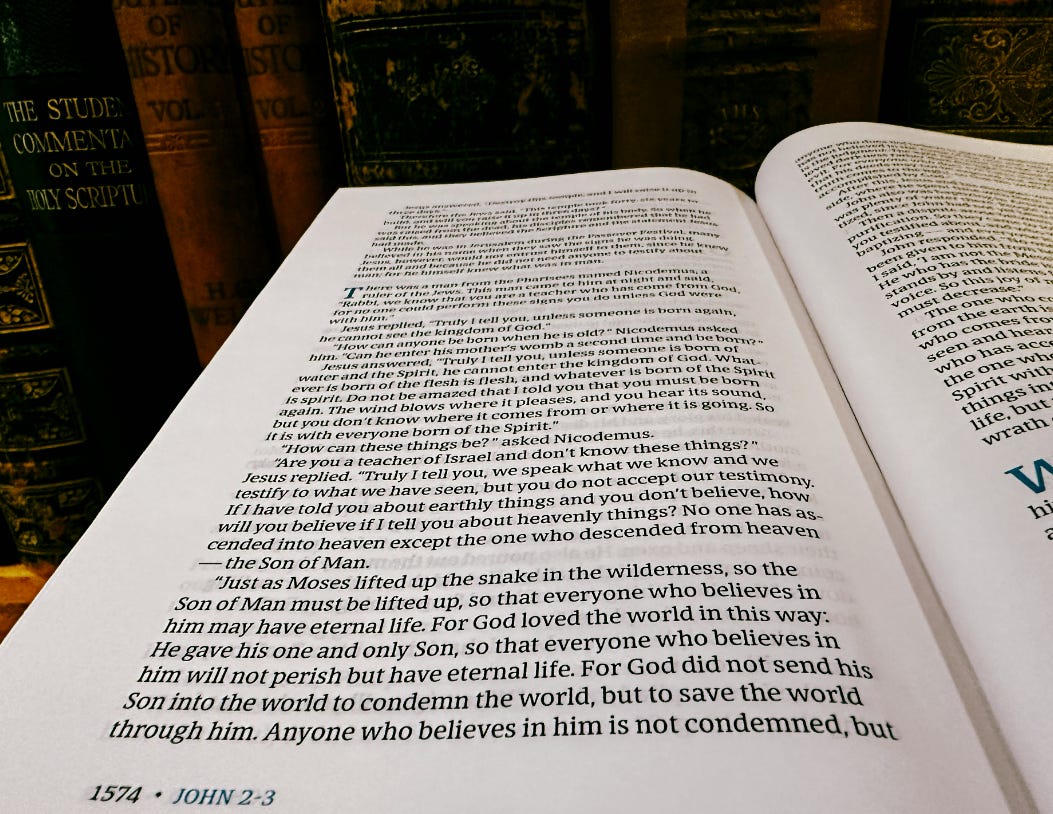
One of my favorites, the Christian Standard Bible (see above for John 2:19–3:18a), didn’t make the list, but I think it’s the best combination of a word-for-word and thought-for-thought translation. Highly recommended.
#6 - A Small Word of Advice
Don’t turn Bible translations into tribal markers. This is among the least helpful things I see—and endure—as an evangelical pastor. Bible translations aren’t sports teams to whom you pledge lifelong allegiance and boo the rest from the stands. There aren’t really “good” vs. “bad” translations; rather, there are more or less reliable translations.
In my experience, people with the strongest opinions about why this translation is the best and why that translation is the worst often lack basic familiarity with how translation works, or are fixated on a single disputed issue that has become a personal hobby horse, or just parrot their pastor’s or professor’s opinion, or were convinced by a meme online.
Don’t get caught up in that nonsense unless you plan to specialize in biblical linguistics and translation theory. That work matters, of course, so someone has to do it. But for most of us—the overwhelming majority, in fact—there’s no obligation to contribute to the noise and to repeat half-understood arguments. Just find a quality translation that you understand, and roll with it.
Imagine Bible translations as players on the same sports team, each occupying a different position. The goal is the same—to ‘win’ by conveying meaning faithfully—but their strengths (‘positions on the field’) differ. One may excel at close textual work, another at clarity, another at narrative flow. When they ‘play’ together, they work toward the same goal, i.e., understanding God’s word rather than competing for loyalty. “I follow Crossway.” “I follow Zondervan.” “I follow James I!”
Paul would like a word.
#7 - Getting Practical
To see why it’s important to compare multiple English translations, let’s consider a single, very familiar, verse.
James 1:5. It’s short, frequently quoted, super popular in the LDS world, and often memorized in the King James Version. Comparing how different translations handle it reveals what is gained—not lost—when clarity is allowed to do its work.
Jeff McCullough recently walked through this exercise on Hello Saints!, and it’s a good illustration of the basic method. We’re not trying to crown a winner here. Remember, they’re all on the same ‘team’ with the same ‘goal,’ i.e., understanding the word of God.
The King James Version reads:
“If any of you lack wisdom, let him ask of God, that giveth to all men liberally, and upbraideth not; and it shall be given him.”
For readers raised on the KJV, this sounds super familiar, even reassuring. For many modern readers, however, several phrases create friction.
“Lack wisdom” expresses absence, but not necessarily desire. I lack a thousand-dollar repair bill for a busted transmission, though I certainly don’t want one. James assumes that wisdom is a good to be desired, something the reader longs for, but that assumption isn’t explicit in contemporary English.
“All men liberally” poses a couple different problems. In modern usage, liberal usually signals political or social categories, not generosity. The older sense, “abundantly,” survives only as a secondary meaning. And also, the phrase “all men” can sound a bit restrictive. Does God not give wisdom to women or children?
“Upbraideth not” is the steepest hurdle for a modern reader. Be honest. You don’t know what that means instinctively. Most people either have to look it up or guess by context. That’s a shame, because there’s a beautiful promise embedded in this verse here, i.e., that God doesn’t scold, shame, or reproach the asked. But it’s obfuscated by Jacobean vocabulary.
Now consider the New International Version:
“If any of you lacks wisdom, you should ask God, who gives generously to all without finding fault, and it will be given to you.”
Now, we can intuit better the spirit behind this verse.
“Gives generously to all” captures the idea behind the Greek pasin, which means simply “to all,” without narrowing the scope to men—in fact, the word for “men” isn’t even present in the Greek text to begin with. So, of course, women and children are also invited to pray for wisdom.
“Without finding fault” melts away shame. God doesn’t blame you for your lack of wisdom. (Read that again; it’s important.) James 1:5 doesn’t tell you to come God sheepishly, hat-in-hand, to ask for wisdom because you’re too dumb to understand something. No! You just can’t see how the pieces fit together from your vantage point, but God can. So, you turned to God rather than the world for wisdom. Well done! That posture is commended, not corrected.
The New Living Translation presses this even further:
“If you need wisdom, ask our generous God, and he will give it to you. He will not rebuke you for asking.”
Notice the shift from “lack” to “need.” Wisdom is no longer framed as a mere absence; rather, it’s a good the reader actively seeks. The translators also describe God as “generous.” Granted, that adjective doesn’t appear explicitly in the Greek, but the interpretation is appropriate because a God who gives generously is, by implication, a generous God. The translation applies God’s action to God’s character, remaining well within the author’s likely intent.
Most striking is the final line: “He will not rebuke you for asking.” I love this because the NLT makes it unmistakable that God isn’t irritated by your request. He doesn’t sigh and roll his eyes and remind you that you should’ve known better by now. Asking for wisdom is not a moral failure; it’s an act of humble dependence.
With the KJV, NIV, and NLT side-by-side, James 1:5 takes on a more textured, meaningful form, doesn’t it?
Alright, that’s enough from me. If you’d like, I can revise this essay in Jacobean English to compare. ; )

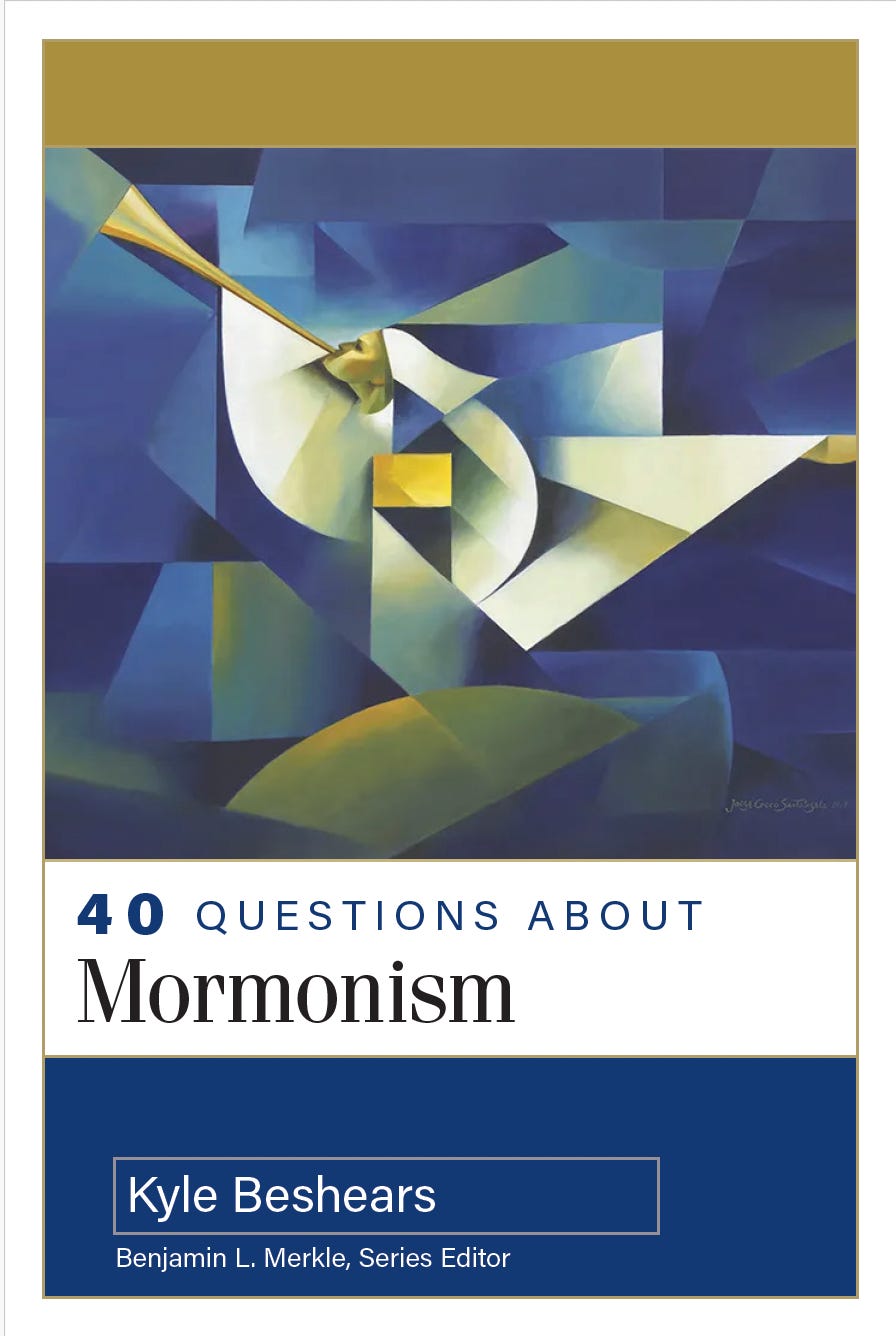
📘 Coming February 2026: 40 Questions About Mormonism
If you’ve appreciated this essay, you’ll love my forthcoming book, 40 Questions About Mormonism (Kregel Academic). It’s written for traditional Christians who want clear, charitable, and biblically faithful answers to the most common questions about the Latter-day Saint faith and tradition.
PRE-ORDER TODAY and download three free chapters while you wait.
As always, I enjoy reading from your perspective
Great article. I forwarded it to my wife and kids. A couple of weeks ago, my wife bought a copy of an ESV Bible. I poked at her a little bit over it, so when the Church made this change, she threw my teasing back at me. I haven't shopped for it yet, but I'd love to find a side-by-side version with the KJV and ERSV.
A few years ago, while doing some work in Kentucky, a friend invited me to join a small group meeting. It was among five Evangelical business owners who meet often to help each other with business decisions, review financials together, etc. They start each meeting with a brief scripture study and that day it was John 15.
I'm not sure which Bible version they were reading from, but I was following along on my trusty Gospel Library app, which is, of course, the KJV.
We got to verse 15 and whomever was reading used the word, "slaves", rather than "servants", and candidly, the wording was very jarring to me. The idea that Jesus would refer to the Twelve and His other disciples as "slaves" took me right out of the moment. When it was my turn to read, I actually went back to verse 15 first and commented on the difference.
I have not yet taken the time to go back and research how different translations treat John 15:15 and why other may have chosen the word "slave" over "servant", or which word is more correct. Eventually, I will because that memory surfaces every now and then and bothers me a little.
On the flip side, I personally always refer to the third member of the Godhead as the Holy Spirit. I think part of that came from living in the Bible Belt for so many years and having good conversations with my Evanglical friends, and I think that part of it comes from the modern view/definition of the word "Ghost" which I don't love. "Spirit" better captures who He is, in my opinion.