


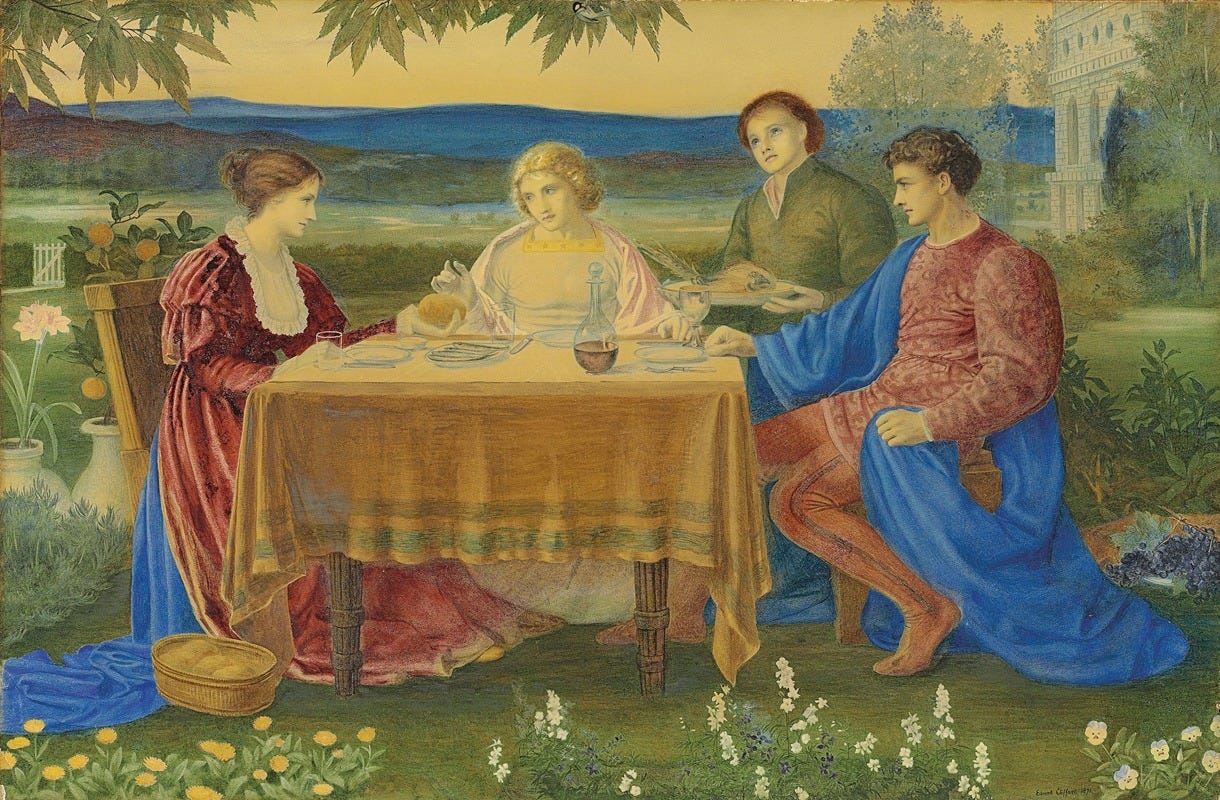
“Some have entertained angels unawares” by Edward Clifford (1871)
In the first essay of this series, I tried to show that Christians have been thinking carefully about non-human intelligence (NHI) for the better part of two thousand years, and that the tradition is in remarkably good shape. While they wondered how the science and theology worked, none seem to have worried about whether human beings would still be special if the universe turned out to be crowded.
So, if the historical Christian conversation about NHI was that confident, why is the contemporary Christian conversation so anxious? Why do thoughtful believers hedge or qualify or change the subject when the topic comes up?
I want to suggest, in this essay, that the answer is not in our theology; rather, it’s in something further down stream, something we don’t usually think about, because its part of the Zeitgeist in which we live, part of the air we breathe. We have, somewhere along the way, stopped genuinely believing in the NHI our own tradition tells us are already here. We profess them, sure, but we don’t actually expect them.
At any case, my central proposition for the essay is this:
We probably don’t inhabit the world that the Bible assumes.
And because we don’t, we’re not equipped to think about—let alone discuss—the prospect that humans aren’t the most intelligent things in God’s creation.

Entertaining Angels Unawares
“Do not neglect to show hospitality to strangers, for thereby some have entertained angels unawares” (Hebrews 13:2).
Read that again.
Notice how straightforward, even nonchalant, the author is about the incredible hypothetical that we have interacted with angels without knowing it. The book of Hebrews is, implicitly at least, assuming that encounters with angels happen, in ordinary life, and often enough to warrant a general rule of Christian conduct.
Such encounters are framed as a live possibility for everyone, as mundane as a person inviting a traveler in for dinner. They aren’t remarkable visionary experiences beholding terrible creatures levitating with wings, ringed with unblinking eyes. There’s nothing mystical about it.
The angel looked like Carl from Accounting.
I’ve heard arguments that “angels” here simply means ‘messengers of the gospel.’ They’re human evangelists. This is, in my opinion, a modernist’s take mapped onto the New Testament, maybe even an embarrassed sensibility trying to make the book of Hebrews palatable to a skeptic’s tongue.
Yes, the Greek angelos can mean “messenger.” But the word appears thirteen times across Hebrews, and in every other instance it unambiguously means supernatural beings. The whole argument of chapter 2 is that Christ is superior to the angels. No one reads that as ‘Jesus outranks traveling preachers.’ Of course He does. Besides, any first-century Jewish-Christian would have heard “entertained angels unawares” and thought immediately of Abraham at Mamre and Lot at Sodom. If angelos just means “human evangelist,” the verse is nonsense: Be hospitable to strangers, because some of those strangers might turn out to be strangers. There’s nothing to be unawares of. It’s eisegesis driven by the presuppositions of a disenchanted world.
And that’s precisely my point.
We’ve become so modernized—so ‘sophisticated,’ so ‘material’—that we can’t take this advice seriously. This verse is telling Christians that God may send non-human, angelic intelligent beings to receive your hospitality, and that you can’t readily distinguish them from humans, so the appropriate response is, therefore, to be hospitable to everyone, just in case.
Do you really believe that?
Be honest.
The author of Hebrews certainly did. The world this author inhabited was filled with humans and NHIs, both, side by side, in ordinary life.
Now go further.
When was the last time you actually looked at a stranger—in class, at a checkout line, in a coffeeshop—and entertained, in real time, the possibility that you were in the presence of a NHI sent by God? I’m not talking about a thought experiment. I’m asking, when is the last time you saw a person and thought it might be an angel?
If your answer is “never,” I would suggest you don’t actually believe Hebrews 13:2. You believe that the verse is in the Bible.
But that’s a different thing.
Ok, so, what am I doing here? Am I saying we should be angel detectors, always on the look out? No, because that’s not the point Hebrews 13 is making. What I’m doing here is stress-testing the gap between what you profess and what you expect. You can profess Hebrews 13:2 without expecting Hebrews 13:2. You can affirm it without ever expecting it to show up as a live category in the way you actually move through the world. That gap is what the rest of this essay is about. It’s where, I’m going to argue, our anxiety about NHI originates.

Functional Materialism
Now, let me press harder. Suppose a Christian friend came to you, confiding to you strange things that clearly trouble them.
They say you something like: “I think there’s something demonic going on in my house. I have been waking up at 3 a.m. because I feel like I’m being watched. One of my kids says they’ve heard voices at night telling them we don’t love her, and that she is bad.”
What’s your immediate response?
Be honest.
Most of us, raised in late-modern Western Christianity, would feel an immediate cluster of reactions that we’re too embarrassed to admit. Concern, of course, but concern of a particular kind.
Are they sleeping enough? Have they been under stress at work? Is there a history of mental illness in the family? Should I gently suggest their child see a therapist?
Now, granted, these aren’t bad questions. Sleep and stress and mental health; these are all real factors of life, and wise pastoral council addressed them. But notice what has happened: the order of explanation has been inverted. The first move of our modern Christian mind, when confronted with a report of demonic activity, is to look for natural explanations, and then only to consider supernatural ones as an ancillary category.
It’s the explanation we reach for when nothing else fits, when all other options are exhausted.
The New Testament never works that way.
It treats demonic activity as one possiblility among others, weighed alongside ordinary causes, with no particular embarrassment about taking the supernatural option seriously when the evidence suggests it.
Now, to be clear, I’m not arguing for a return to some primitive cosmology. And I’m certaintly not suggesting we ignore mental health, or substitute exorcism for medication, or pretend that every sensation of dread is a demon. There are plenty of quacks and grifters in the deliverance ministry world who prey on that sort of thing, and scripture’s command to test the spirits applies as much to charismatic excess as it does to anything else.
What I am asking is for us to notice that the practical disposition of most Western Christians toward activity by NHI is functionally identical to the practical disposition of a thoughtful secular materialist. Both of us reach for naturalistic explanations first. Both of us treat the supernatural as embarrassing until proven otherwise. The difference between us is that the materialist is being consistent with her metaphysics, but we aren’t.

Screwtape’s Ideal Worldview
Ok, so, what happened?
C.S. Lewis can help explain. He predicted all this back in the 1940s.
The Screwtape Letters contains what is probably the most cited passage about devils in twentieth-century Christian writing: that the two errors a person can fall into about them are disbelieving in their existence, and being unhealthily fascinated with them, and that devils are equally pleased by both.
What’s less often noticed is the strategic claim that follows from this in the letters themselves. Screwtape, advising his nephew Wormwood on how to corrupt his ‘patient,’ makes it explicit early on: do not, under any circumstances, allow him to think clearly about the supernatural. Don't argue with him, because argument might wake him up. Just keep him comfortable, in the half-asleep assumption that “real life” means “ordinary material life,” and that anything else is by definition unreal, or eccentric, or for the unstable.
Screwtape isn’t particularly worried that his patient will become a pagan, or a magician, or a Theosophist. He’s worried that his patient will become Christian, and the most reliable barrier between his patient and Christianity is the unspoken assumption that the supernatural isn’t part of the real world. Materialism, Screwtape says, is one of Hell’s most useful philosophies, not because it’s true, but because materialism makes the gospel sound unrespectable.
This is the part of The Screwtape Letters that I think modern Christians need to consider most. Lewis is making the point that the demons want us not to believe in them, and the materialist intellectual climate of the modern West is precisely the climate they would design if they could. The skepticism we feel about the supernatural isn’t, on Lewis’s reading, a neutral byproduct of scientific progress; rather, it’s a strategically positive condition for the very beings whose existence it denies.
The didn’t create it, but they’ve certainly leveraged. “The more sinister, the more Satanic,” is a mantra in spiritual abuse counseling. It certainly applies here.
Now, you don’t have to accept Lewis’s full demonology to agree with his argument. You only have to ask: “If there were beings whose work depended on humans not believing in them, what intellectual climate would those beings most prefer?” And then, look at the worldview you actually inhabit.
The honest answer is uncomfortable, I know, because the worldview we live is precisely the worldview such beings would want.
At least, that was Lewis’s argument, and I think there’s something to it.

Christian Anxiety about Non-Human Intelligence
Ok, let’s pull these two threads of thought together.
First, if we truly believe the faith we claim to, then non-human intelligence exists. At a minimum, in the forms of angels and demons.
Second, because we’re are late-modern Western Christians, we inhabit a world in which materialism is the de facto worldview, which prevents us from actually believing in non-human intelligence.
So, we say we believe is scripture, but what we actually believe is something like Christian-inflected materialism. And we confess angels and demons, but what we expect is neurology and sociology.
That gap creates the anxiety.
And, again, it’s an anxiety our medieval predecessors didn’t seem to feel. They lived in a world they knew was already full of intelligences besides their own. They weren’t afraid of being outclassed cognitively, because they already believed they were. Angels were, by all accounts, far smarter than we are. I struggle to believe, then, that the discovery of additional NHIs in the cosmos would have been for them a category-breaking event. No, I think it would have been a category-extending one.
So, why would it be for us?
Because it threatens to break the category we’ve allowed to shrink to almost nothing.
We’ve allowed the universe of rational beings to contract, in our practical imagination, to Homo sapiens alone. And once a universe of rational beings is reduced to only us, every potential addition feels like a threat to our place in it.
Now, to be clear, I don’t think our anxiety would be alleviated by better arguments about extraterrestrials. I’m sensing that’s a solution bubbling beneath the surface at the moment, and predict it’s one many Christian leaders will make, or have already started to, e.g., it’s all demonic. (That’s misguided, as I argued earlier.)
The cure, instead, is recovering the enchanted world of Christianity we already profess. If we genuinely believed that we share the cosmos with angelic intelligences greater than our own, then the question of whether we share it with biological intelligences elsewhere would lose most of its sting. We would already know what it feels like not to be the smartest things in the room.
And, that brings me to the question I want to take up in the next essay: If intelligence is not what makes human beings unique, what does? Here, I think, Christianity has an answer that’s not only adequate to the cosmological discovery we may be about to make, but actually clarified by it.
The image of God isn’t the rational mind. It’s something else, something the angels do not posess, something the cleverest possible alien would not threaten.
We will get to that next.
Looking for your next theologically-informed sci-fi adventure?
Check out Adam’s Choice, the first in the Broken Promises series, casually and occasionally written by your’s truly.

Adam’s Choice follows a reluctant commander leading humanity’s last hope to a new world, only to face manipulation, loss, and divine mysteries that challenge the mission’s purpose, and his budding faith.
Get a copy for $2.99, and dive in!
Excellent analysis. I think we have used this text as part of our LDS version of “fire and brimstone” to try and subtly manipulate people into doing the right thing, rather than relying on the transformative power of Christ’s grace. I think it’s changing in the LDS community but we have a ways to go.