


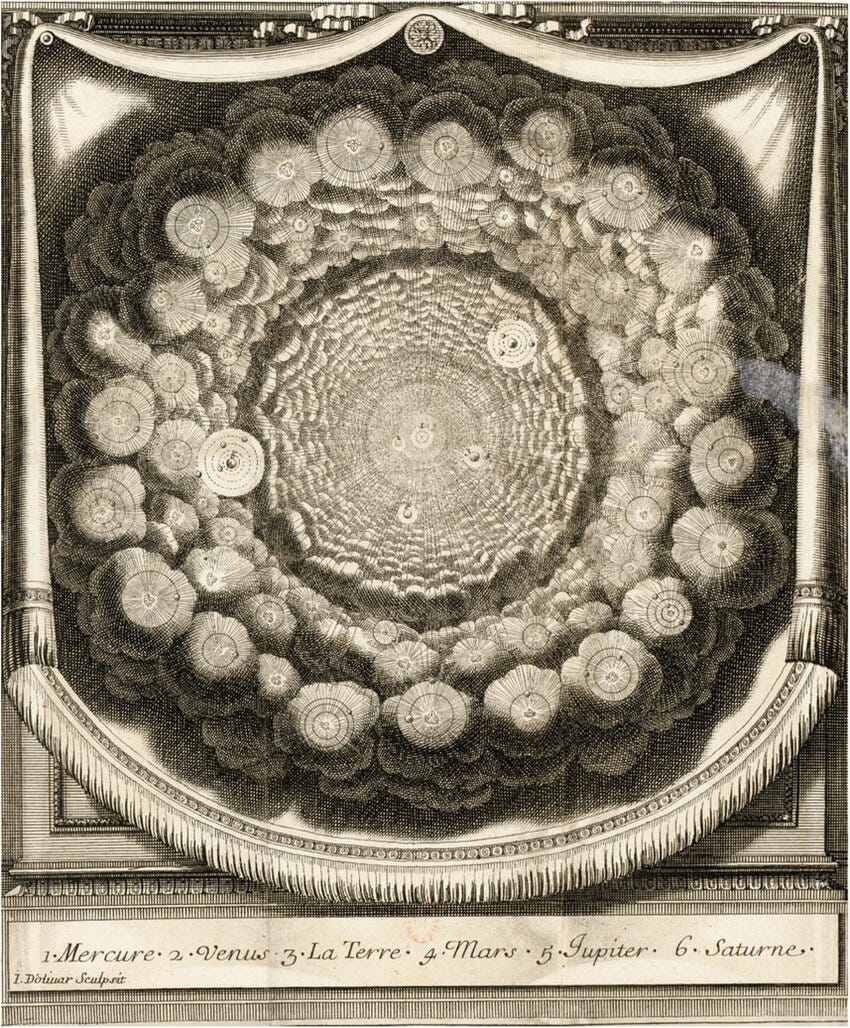
Frontispiece of Fontenelle’s Entretiens sur la pluralité des mondes, engraving by Jean Dolivar (1686)
Note: This essay is the first in a multi-part series titled “Theology at the Edge of the Cosmos.” I'm writing about the phenomena now not because I think disclosure is imminent, but because the conversation about non-human intelligence is happening and picking up speed with or without the church. I’d rather we not smirk our way into irrelevance on this one.
In Anthony Trollope’s Barchester Towers (1857), Mrs. Eleanor Bold is teased a bit about her views on life beyond Earth:
“Are you a Whewellite or a Brewsterite, Mrs. Bold?” said Charlotte, who knew a little about everything, and had read about a third of each of the books to which she alluded.
“Oh!” said Eleanor; “I have not read any of the books, but I feel sure that there is one man in the moon at least, if not more.”
“You don’t believe in the pulpy gelatinous matter?” said Bertie.
“I heard about that,” said Eleanor; “and I really think it’s almost wicked to talk in such a manner. How can we argue about God’s power in the other stars from the laws which he has given for our rule in this one?”
“How, indeed!” said Bertie. “Why shouldn’t there be a race of salamanders in Venus?”1
In his Astrobiology and Christian Doctrine, Andrew Davison highlights this exchange for its insight into a cultural moment.
The characters are sophisticated socialites, not theologians. Being a “Whewellite” or “Brewsterite” meant subscribing to one of two schools of thought: 1) following William Whewell, who published Of the Plurality of Worlds in 1853, arguing on Christological grounds against life elsewhere; or 2) following David Brewster, who replied the next year with More Worlds Than One, arguing for it.
The “pulpy gelatinous matter” Eleanor is teased about is a dig at Whewell’s speculation that any life on Saturn or Jupiter would be “boneless, watery, pulpy creatures.”2
Notice, though, how the exchange was public and quite ordinary. It was an ongoing controversy that educated Christians debated.
“How can we argue about God’s power?”
How indeed.
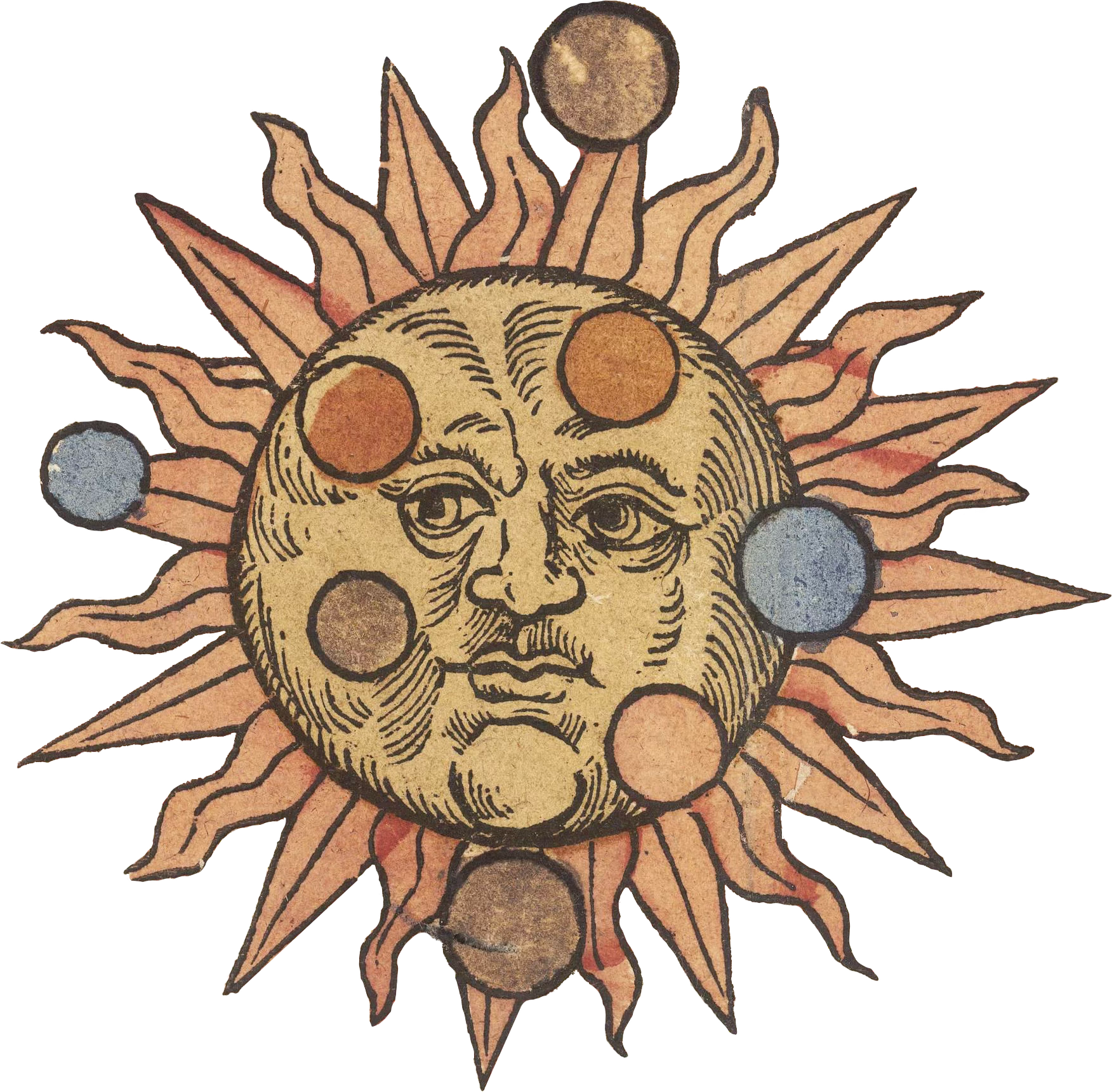
Just a clarification, since I anticipate returning to similar ones through this series. Obviously, there are no salamanders on Venus. We know what the Victorians didn’t, that Venus is a massive, toxic greenhouse hellscape where sulfuric acid rains down. Not very conducive to fragile, aquatic lizards.
But that’s beside the point. Almost none of the nineteenth-century guesses about astrobiology were correct. The question is the underlying posture, i.e., the easy assumption that the cosmos God made is generous enough to teem with life, and that, whatever those creatures turn out to be, the gospel still applies.
A century and a half later, Carl Sagan wondered why no major religion had looked at modern cosmology and concluded, “This is better than we thought.” Instead, he complained, religious people seem to say: “No, no, no. My god is a little god and I want him to stay that way.”3
Sagan’s complaint is myopic. The Barchester Towers scene is just one piece of evidence. Christian theologians have been discussing other worlds and potential inhabitants since at least the Middle Ages, and the conversation extends back through the Church Fathers to the pre-Socratics. They have, generally speaking, found the prospect more invigorating than threatening. Some, like Nicholas of Cusa, held important church positions. Others, like Richard Baxter, found cosmic life theologically consoling.
I think it’s an uninteresting question to ask whether Christianity can survive the discovery of non-human intelligence. The more interesting question is why, in our particular moment, so many Christians act as though it can’t.
Before moving on, almost everything historical and theological that follows is drawn from Davison’s Astrobiology and Christian Doctrine. He was the right man for the book. Davison is Regius Professor of Divinity and residentiary canon at Christ Church, Oxford, and wrote Astrobiology while a resident at Princeton’s Center of Theological Inquiry, in partnership with NASA.4 In my opinion, Davison has produced what is presently the definitive theological treatment of the field.
For this essay, I rely heavily on him. The historical narrative is his, as is his survey of the debates through the ages. Where I quote a primary source, I’m almost certainly quoting it through him.
What I’ve done is more modest: I’ve created a taxonomy based on his research. Davison’s treatment is organized around loci communes (e.g., creation, angels, revelation). I’ve condensed and rearranged some of that material into twelve positions under three axes: 1) Whether other worlds exist; 2) Whether those worlds are populated, and 3) What forms of non-human intelligence (NHI) Christianity has historically considered.
In short, the taxonomy is mine, but the substance is his. Read Davison if you want to read seriously here.
Think of this essay as a doorway.
A Brief Note on Two Important Terms
For the purpose of these essays, by “non-human intelligence” (NHI), I mean any rational, self-conscious being other than human beings, so, broader than “extraterrestrials,” including angels and demons, antipodeans, the fairies and elves of folk Christianity, etc.
A “world” is defined as any reality in which beings live and move and have their being—whether perceivable by humans or not—bounded by physical distance, time, dimension, or some other ordering principle that is created and sustained by God the Father, through the Son, in the Holy Spirit. This definition covers exoplanets, parallel universes, the angelic realm, and whatever else God’s creation contains. It rules out only realities not held in being by the Triune God, who was, is, and always will be utterly and completely distinct and Other than all things He creates.
With these terms defined, we now to turn to the taxonomy at hand, namely:
How have Christians throughout history thought about other worlds and their potential inhabitants?
Axis 1: Positions on Whether Other Worlds Exist
Impossibilism. Other worlds cannot exist. William of Auvergne (d. 1249) held the impossibility lay in the nature of “world” itself. Albert the Great (d. 1280) and Thomas Aquinas (d. 1274) arrived at the same conclusion by a different route, arguing from the unity of God’s order: a “world” just is a single ordered whole, and since everything God creates stands in ordered relation to everything else and to God, all created things belong to one world by definition.5 Interestingly, the chief medieval objection was not about Christology or soteriology; rather, it was their view of physics. Since bodies have a single natural center of gravity, and Earth was considered the universe’s center, all objects would be attracted to and eventually collide with Earth. Why, then, would God create worlds teeming with life only to have them collide and destroy us all at some point in the future?
Possibilism. God could create other worlds. This view gained dominance after a turning point, in 1277, when Étienne Tempier (d. 1279), Archbishop of Paris, condemned over two hundred propositions, including the assertion that “the first cause cannot make more than one world.” Bonaventure (d. 1274), for instance, taught God could make “a hundred worlds.” Richard of Middleton (d. 1308), William of Ockham (d. 1347), and Jean Buridan (d. 1362) all affirmed this possibility. William of Vaurouillon (d. 1463) pushed it to its limit, arguing God could make an infinite number of worlds. Notably, he was also among the first Western Christian theologians (as far as we can tell) to explicitly consider what inhabitants on another world would mean for sin, salvation, and the Incarnation.
Actualism. Other worlds exist, and they are inhabited. Nicholas of Cusa (d. 1464) wrote in On Learned Ignorance (1440) that “the regions of the other stars are similar to this, for we believe that none of them is deprived of inhabitants.” Notably, he did so without losing his standing as a cardinal. Giordano Bruno (d. 1600) advanced the same thesis a century later and was burned, though, as Davison points out, his condemnation stemmed not from his cosmology but from his collapsing of the Creator-creation distinction. By the seventeenth century, actualism had broad sympathy across confessions. Johannes Kepler (d. 1630) asked whether God could possibly have “used up all His skill on the globe of the Earth,” while Tommaso Campanella (d. 1639) argued, in his Defense of Galileo (1622), that beings on other worlds, not descended from Adam, would not be fallen. Richard Baxter (d. 1691) found consolation in the thought of cosmic life. It eased his anxiety over the number of the damned by reframing the question of scale. The damned on Earth aren’t fewer in number, sure, but they’re fewer in proportion to the whole of God’s creation. Zoom out to a cosmos filled with inhabited worlds, Baxter argued, and the objection to God’s goodness loses much of its force.
So, as far as other worlds are concerned, Christians generally fell into one of three camps: 1) God could but wouldn’t create other worlds, 2) God could and might create other worlds, and 3) God could and has created other worlds.
What they all agreed on was God’s ability; their disagreement concerned God’s will.
Now, if the possibilists and actualists were correct, what kind of life, if any, inhabits God’s worlds?

Axis 2: Positions on Whether Other Worlds Are Populated
Uninhabited worlds. Some believed the other worlds were simply devoid of life, regardless of their conditions. This position affirms the plurality of God’s planets without committing to the plurality of God’s creatures.
Worlds inhabited only by non-rational life. Microbes, plants, animals, but no rational creatures. Anything created on Days 3, 5 and 6 before noon were fine, but the afternoon’s creation—other Adams from alien dust—was a step too far. Microbial life on Mars would fall here. This position is, theologically, the safest option if one believes in other worlds, because it leaves Christology untouched. Edward Maunder, in 1913, conceded that this sort of life might exist elsewhere in the cosmos; however, he argued that given the “exceptional” conditions that are require for life as we know it, the number of planets meeting these conditions must be “few in number,” meaning such life—and thus NHI—is incredibly rare.6 Presently, Christian astronomer Hugh Ross is among the leading evangelical voices arguing the same. Maunder admirably ends his book suggesting Christians should be less interested in looking for other worlds than the world to come. That’s true, but beside the point.
Worlds inhabited by unfallen rational creatures. This was Vaurouillon’s and Campanella’s hypothesis: rational beings exist elsewhere but, not being descended from Adam, haven’t inherited his sin. This quarantines the Fall to Earth alone, and preserves classical soteriology. This is the general assumption C.S. Lewis takes in The Space Trilogy, which will be explored in later essays.
Worlds inhabited by fallen rational creatures. This is the hard case to defend, and Davison surveys only serious answers. In sum, God has either 1) brought about a single cosmic Incarnation embracing all rational creatures; 2) multiple Incarnations of the Son in different natures; or 3) entirely distinct economies of grace, or what I call “Cosmic Dispensationalism.” This is where Christians have argued most strenuously. The Christological worry—Phillip Melanchthon (d. 1560), when speaking of inhabitants on other worlds, named it thus: “the Son of God is one . . . died and was resurrected only once”—is the chief objection, and the one I see most often today among those who have thought this through. The concern is about the mechanics of Christ’s atonement, not whether human beings would still feel special. I respect this concern greatly.
Axis 3: The Christian NHI Tradition Beyond Other Worlds
With those two axes in mind, I’d like us to consider how Christianity has always thought about the existence of NHI.
Angels and demons are the most obvious example. In Christian thought, angels are not biological. Material, perhaps, but in a way we don’t understand. They are, however, more intelligent than humans. Aquinas held them vastly more powerful in cognition and will than any embodied creature. As Davison puts it, the inclusion of angels means “human beings are not the most elevated or advanced beings within creation.” Christianity has always said we are outclassed.
Long ago, Christianity entertained the idea that celestial bodies could be ensouled or, if not, then acted upon by non-divine intelligence. I read somewhere, but don’t recall now (and couldn’t track it down), that some believed the ‘wandering stars’ were being pushed or pulled by inferior intelligences, i.e., an intelligence below angels but beyond humans.
Next, consider the antipodeans, who offer a remarkable analogue to contemporary NHIs. Long before modern concepts of aliens and Area 51, there were antipodeans and the ‘wild’ idea of people inhabiting lands across oceans. Some antipodes were even said to be people living on the underside of Earth. The theological objections to their existence were serious. Augustine (d. 430), to his credit, accepted the spherical geometry of the globe, but rejected antipodean inhabitation on Adamic grounds. In 748, Pope Zachary threatened a priest with excommunication for teaching “other men beneath the earth.” In short, such peoples couldn’t descend from Adam, couldn’t have heard the gospel, or couldn’t exist in a creation ordered outside the known world. Albert the Great, though, accepted antipodean inhabitation, and saw no theological problem with it. This debate serves as a structural rehearsal of the exoplanet debate, conducted on Earth, and it offers a rich historical precedent for our modern discussions about NHI. After the Europeans discovered the Americas, antipodes were no longer theoretical; instead, they became the ‘opposite Other.’ Will Christians today, who reject NHI, one day look like the medieval theologians whose position the discovery of the Americas falsified? In other words, will today’s theological reasons for denying NHI prove as fragile as yesterday’s reasons for denying antipodeans?
Next, we turn to folk Christian intelligences. These included creatures beyond angels and humans, such as fairies and elves. Davison cites these as evidence of “how cultures steeped in Christian theology have readily entertained that there is more to the sum of sentient life than the human species.” Granted, these are folk intelligences, not biblical, but I bring them up to demonstrate how Western Christians in the past enjoyed a more robust theological imagination than we do today.
Finally, contemporary research into “diverse intelligences” is prompting a return to questions Christians used to ask easily. The octopus is, in some respects, a non-human intelligence sharing our planet right now. Artificial Intelligence, with all its rapid advances, is another example. I hesitate to apply the term “intelligence” to AI, though, and anticipate a future where Artificial General Intelligence (AGI) will far surpass the Turing Test, convince many of its sentience, and compel us to adopt a term like “Alternative Intelligence,” lest we be seen as bigoted Luddites. Richard Dawkins’s recent misidentification of LLM output with genuine consciousness is an example of that initial step.7 (Neo-Darwinian materialists, it seems, are especially vulnerable to make this error.)
What This Taxonomy Tells Us
This taxonomy, while perhaps not perfect nor exhaustive, offers a framework for understanding how Christians have historically considered other worlds and NHIs. Two consistent patterns emerge.
First, the primary resistance to other worlds was almost always scientific rather than theological. As Davison observes, what often “held people back was the science of the day, not the theology.” Today, it’s exactly reversed.
Second, where genuine theological objections did surface, they were almost entirely Christological. Whether human beings are smarter than the octupus was never in question.
But something changed.
When Christians today argue—or, better, worry—about non-human intelligence, the question that animates them isn’t “What does this mean for the Incarnation?” but “What does this mean for us?” There’s an undercurrent of anxiety that Christians in the past didn’t seem to feel.
Between roughly the seventeenth and nineteenth centuries, the educated Christian West moved from questioning whether other worlds and other lives existed to broadly accepting that they did, or might. Trollope’s Barchester Towers is a snapshot of that shift, which had already occurred at the level of popular sensibility. We wouldn’t have War of the Worlds or Star Wars or Dune without that shift.
But, in very recent history, we stand at a new inflection point regarding NHI more broadly. Confirmed exoplanetary microbial life—which is, by most astrobiologists’ estimates, decades (not centuries) away—will force a change in the conversation. So will the possibility of confirmed exoplanetary rational life. Obviously, whatever phenomena lie behind the well-attested but poorly-explained UAP sightings—now under congressional and Department of War investigation—are at the forefront. Also at the forefront, as I alluded to earlier, is the moral status of advanced terrestrial non-human intelligences, i.e., AGI representing another ‘species’ of NHI altogether.
This is the inflection point I spoke about earlier: 21st-century Christians, I think, need to make the same move Mrs. Bold had already made by 1857. We need to move from questioning the existence of non-human intelligence to accepting it as a theoretically live option, and a probable feature of the cosmos God has made. Because if we don’t, then I predict three failure modes will follow:
First, the dismissive or condescending posture. Many Christians handle questions about NHI with a weary smirk: “The Bible doesn’t teach that.” This posture confuses the absence of explicit biblical teaching with the presence of biblical prohibition. The educated public knows science is moving; philosophers, scientists, and militaries take these questions seriously. When the church alone treats them as beneath comment, we look exactly like what Sagan accused us of being.
Second, the knee-jerk demonological reduction. A second contingent defaults to the conclusion that all reported NHI must be demonic. I do think some NHI phenomena are demonic or demonically-influenced—some abduction stories can’t be squared away, to me, without it—so, spiritual discernment is real and necessary. But the wholesale reduction is a category error. It treats a vast set of phenomena—some odd but prosaic sightings, some misidentified terrestrial craft, some possible life from other planets or dimensions, some perceptual or psychological, some exotic physics, some indeed spiritual—as if they were one thing. The medieval tradition was much more careful: angels, demons, antipodeans, fairies, and inhabitants of other worlds were distinguished from each other. We’ve lost that taxonomic discipline.
Third, the forfeiture of the conversation. This worries me most, as a pastor. When Christians refuse to engage NHI seriously, the conversation doesn’t stop—it happens without us. And it happens in the hands of secular materialists, who cast religion as obsolete, e.g., Mick West and Neil deGrasse Tyson; through scholars like Diana Pasulka, whose work reads UFO phenomena through a religious-but-post-Christian lens; among influencers and podcasters whose theology is non-extant or, at the very least, borrowed and thin, e.g., Joe Rogan and Shawn Ryan; and via New Age and esoteric movements happy to offer their own framing, e.g., Raelianism. The young Christian told the church has nothing to say about NHI will not conclude NHI is unimportant. She will conclude the church is.
The tradition I’ve been mapping, inspired by Davison, isn’t a defensive crouch; it’s the opposite. Aquinas, Cusa, Vaurouillon, Baxter, and “Mrs. Bold” could entertain widespread non-human intelligence without their faith being shaken, and without ceding the conversation to anyone else. They had a taxonomy, built from a theology of creation generous enough to hold whatever showed up. And, in turn, they enjoyed the confidence that whatever God had made, God could also speak about, and so could we.
The short version of my argument across this series is that something happened between the time of our theological ancestors and the present day that taught us to locate human uniqueness in intelligence. We started calling ourselves Homo sapiens. We made rationality the criterion of human worth. And then, when astronomy, biology, and now artificial intelligence began to suggest rationality is less scarce than we had assumed, we panicked.
The Christian faith offers a different account of what makes us unique. It doesn’t depend on our being the smartest things in the room.
It never did.
But that’s for the subsequent essays.
For now, I’d like to answer the teased question put to Mrs. Bold: “Why shouldn’t there be a race of salamanders in Venus?”
Because we know now that they’re not the sort of creature that could survive on Venus, but that doesn’t mean they couldn’t survive elsewhere.
And if they could, what else?
Looking for your next theologically-informed sci-fi adventure?
Check out Adam’s Choice, the first in the Broken Promises series, casually and occasionally written by your’s truly.
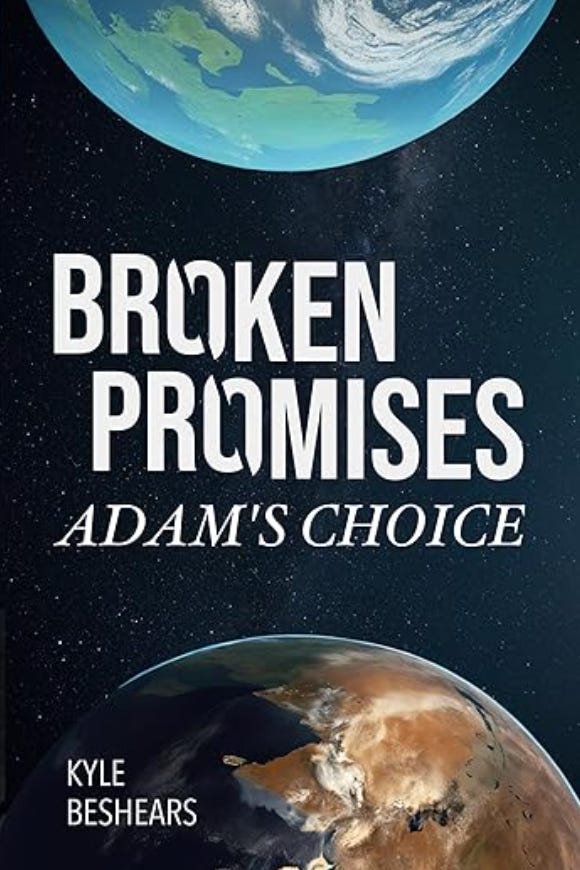
Adam’s Choice follows a reluctant commander leading humanity’s last hope to a new world, only to face manipulation, loss, and divine mysteries that challenge the mission’s purpose, and his budding faith.
Get a copy for $2.99, and dive in!
Anthony Trollope, Barchester Towers, 298–299.
William Whewell, Of the Plurality of Worlds, 183.
Carl Sagan, Pale Blue Dot, 50.
Kaya Burgess, “Heavens above: Nasa enlists priest to prepare for an alien discovery,” The Times, December 22, 2021.
In an earlier version of this essay, I presented Aquinas’s view of other worlds as unfitting to God, but neglected to tease out why. Thanks to my friend Jared Selim for pressing me for clarity and precision on this point.
Edward Maunder, Are the Planets Inhabited? 161.
Robert Booth, “Richard Dawkins concludes AI is conscious, even if it doesn’t know it,” The Guardian, May 5, 2026.
You're worried the church will be irrelevant in the conversation about NHI because it's too dismissive; I'm worried the church will be irrelevant in the conversation because they'll be too eager to follow the mainstream narrative, and leave discernment behind. I think you should add that as a potential failure mode.
I know you mean well. That treatment of Aquinas is EXTREMELY reductive and baffling. Have you not read the Summa's First Part, Q. 47, Art. 3, where he addresses this question in-depth?