


Note: Parts of this essay have been adapted from a forthcoming book review.
Recently, an evangelical biblical scholar and apologist who occasionally engages Latter-day Saints and Mormonism was asked a question by a Latter-day Saint on his live YouTube channel, The Dividing Line:
What scholarship had he been keeping up with in the field of Mormon Studies?
The apologist, James White, didn’t name a specific book. Instead, he explained he didn’t feel the need to keep up with all the “minutiae” coming out of BYU, and felt it more important to follow the First Presidency and the Quorum of the Twelve, since they’re the pinnacle of LDS doctrine. If you want to know what the Church teaches, pay attention to Church authorities. You don’t need the downstream material.
Fair enough, I suppose, but frankly, I was hoping for a more robust answer. I get this instinct, though. Latter-day Saints believe their prophet and apostles hold a unique authority to declare doctrine. White was, no doubt, right about that.
But imagine the argument in the inverse. Suppose a Latter-day Saint, who postures as an expert in evangelicalism, told an evangelical that he didn’t need to keep up with all the “minutiae” coming out of our seminaries and publishers to understand our faith because he could simply read the Bible alone. After all, among our most well-known doctrines is sola Scriptura, i.e., that the Holy Bible is our pinnacle earthly authority for all matters of faith and practice, and everything else is simply downstream.
We’d object, or, at least, I would. Had I the opportunity with that LDS apologist, I’d hand him Augustine’s Confessions and Calvin’s Institutes. I’d point him to Martin Luther, who shapes our understanding of Paul, and John Owen and Jonathan Edwards, who taught us to search our hearts. I’d give him the dogmatics of Herman Bavinck, B. B. Warfield’s work on Scripture, Bonhoeffer’s The Cost of Discipleship, J. I. Packer’s Knowing God. I’d finally turn him toward evangelical works coming out of our seminaries and the Evangelical Theological Society and Zondervan, IVP, Baker, Eerdmans, etc.
Finally, I’d tell him that it’s not really possible to understand a faith tradition by reading only its source of authority, because you have to understand how its people receive it. Indeed, downstream is where tradition is lived.
A little later, I watched Jaxon Washburn—the Latter-day Saint who put the question to James White—talk about the exchange on an LDS YouTube channel called Ward Radio.
Around the 50:00 mark, the host said something that caught my attention. You can watch or listen to that moment here:
If the link didn’t work, here’s the host’s quote that I’m most interested in:
“Tomorrow, if he wanted to, Dallin H. Oaks [President of the LDS Church], Clark Gilbert [LDS Apostle responsible for Church education], could just shut down any department of BYU that they wanted to, and they thought was misbehaved.”
Now, granted, I don’t know if what the host claimed is actually true. It’s probably a little more involved than Oaks or Gilbert unilaterally shutting down an entire department on a random Friday afternoon. But the force of the point is clear and true, i.e., if the Church owns the institution where most of its theology would happen, then that theology exists at the pleasure of the Church’s leadership.
That’s something I’ve been chewing on for years now, and finally wanted to put my thoughts out there, because I think it affects the way the LDS Church does theology.
A Word About the Apologist
First, though, a word about James White, just to be perfectly clear.
I don’t know him. I’ve never interacted with him nor read his work nor do I follow his channel, but I’ve also been in enough live situations to know that one answer on the fly is such a small peek into someone’s life. I’ve already said I was disappointed by his answer, and I’ll leave it there.
But because I’ve seen Latter-day Saints dunk on White since the moment, I’d like to point out that he seems genuinely interested in LDS scholarship to the degree in which he’s able. He seems like he’s far more interested in textual criticism, so I thought it was cool how he mentioned paying to have Thomas Wayment’s New Testament translation leather-bound and gifted to the BYU scholar. I thought that was very generous act. We need more like it.
Still, to be frank, I think White fumbled the question, but the question itself got me thinking:
Was White’s answer due to a lack of commitment to research on his part, or was it due to a dearth of the material he’d expect to find as an evangelical scholar?
Perhaps it’s both, but part of the reason is the scarcity of LDS systematic theology. Here’s what I mean.
When it comes to Mormon Studies, there’s no shortage of reading. By “Mormon Studies,” I mean the scholarly study of the Latter-day Saint movement in all its branches, by scholars inside and outside the tradition. LDS scholars in history, philosophy, and scriptural studies are thriving. Mormon Studies is a healthy, growing field in the study of religion. Any non-Latter-day Saint who claims expertise in Mormonism should be reading in these areas. If you’re not, then you shouldn’t be considered having expertise in that field. We evangelicals wouldn’t consider a Latter-day Saint an expert in evangelicalism if she’d never read Carl F. H. Henry, George Marsden, Nathan Hatch, Carl Trueman, Thomas Kidd, Nancy Pearcey, or newer voices like Gavin Ortlund and Rebecca McLaughlin.
That’s the standard we’d apply to ourselves, so, do unto others.
Still, I think White’s answer makes more sense once you look at theology, in specific. Theology is one area where I’ve found it hard to find quality work. I can hop on the Church’s website and get official doctrine, and there are great resources explaining that doctrine. What’s harder to find is the next level, i.e., scholars taking a doctrine and working it out at length, testing it against objections, building on what others have written before them, toying with new ideas, etc.
I’m not saying such work doesn’t exist, but it certainly doesn’t exists in the quantity and quality that traditional Christians—Roman Catholic, Eastern Orthodox, and Protestants—are accustomed to.
I’m thinking about the best theological works I’ve read recently. Thomas Joseph White, a Dominican, wrote an excellent treaties on The Trinity: On the Nature and Mystery of the One God (Catholic University of America Press). I really enjoyed Baptist theologian Channing Crisler’s 40 Questions About the Atonement (Kregel Academic). I’m presently reading Carl Trueman’s (a Reformed historian and theologian) Classical Theology for the Modern Mind (Crossway). Note how these authors represent three different traditions looking at three different doctrines. Each book takes a single doctrine and works it out carefully for the church, standing on centuries of prior work.
I suspect that’s part of why the apologist didn’t name a book. The kind of work an evangelical theologian would naturally want to read, like systematic theologies and theological monographs, is hard to find in the LDS tradition. The obvious exception is Grant Underwood’s Latter-day Saint Theology among Christian Theologies (Eerdmans, 2025), but more on that below.
For now, I’d like to make the observation that Latter-day Saints don’t really have the same kind of theological guild that traditional Christianity enjoys.
Why is that?
Traditional Christianies all have professional theological guilds. They have professional theologians who spend their entire careers on the Trinity, the atonement, the sacraments, etc. They publish monographs, supervise doctoral students, debate at scholarly conferences, and critique each other’s work in academic journals. They gather in organizations like the Catholic Theological Society of America, the Evangelical Theological Society, and the Orthodox Theological Society in America, and they publish in journals like Theological Studies, the Journal of the Evangelical Theological Society, and St. Vladimir’s Theological Quarterly.
Latter-day Saints have produced systematic theologians, too, e.g., James Talmage, Orson Pratt, B. H. Roberts, Bruce R. McConkie. But there’s no LDS equivalent to Aquinas’s Summa Theologiae, Calvin’s Institutes, or Barth’s Church Dogmatics. The closest I can think of is Talmage’s Jesus the Christ and Articles of Faith, but those are far more devotional than dogmatics, or what we evangelicals call applied or practical theology. It’s DMin, not PhD, content.
So, why hasn’t the LDS tradition developed a comparable guild of professional theologians?
I see two reasons for this.
First, the nature of revelation in LDS thought.
In traditions with settled creeds and canons, and without a living prophet, theologians work within relatively stable doctrinal frameworks. There are boundaries that won’t—can’t—move (e.g. creation ex nihilo, the Trinity, fixed canon), so the ‘sandbox’ in which to play is clearly defined. Theologians can debate theological meaning and implications, but they don’t expect new prophetic revelation to reshape the doctrinal framework itself.
Latter-day Saints, though, understand doctrine differently. God reveals it through a living prophet, and prophetic teaching is the authoritative means by which doctrine is clarified, applied, or illuminated in response to the Church’s needs. Latter-day Saints see this as one of their tradition’s great strengths.
It does, in my opinion, come with a serious weakness, though.
Think about what a living prophet means for a theologian. Imagine a Latter-day Saint scholar who devotes her career to eternal progression, or eternal families, or a particular element of the temple endowment. She spends twenty years on it and writes the definitive study. Then, prophetic teaching clarifies or reframes the doctrine on a random Saturday session of General Conference. What happens to her work?
It doesn’t disappear, of course, but it’s no longer relevant to present belief and practices. Her life’s work, as valuable is it is, is now as an element of LDS historical theology. Her books and articles now describe what Latter-day Saints once believed and how they reasoned about it. That’s valuable, obviously, but it’s also a different kind of book from the one she wrote.
This is, in my opinion, one reason why so many Latter-day Saint intellectuals are drawn to other fields, e.g., history, philosophy, scriptural studies, sociology, etc.
Systematic theology needs a reasonably stable object on which construct, critique, revise, and coalesce. Continuing revelation makes (theoretically) nearly every theological object movable. As long as new revelation remains possible, no LDS systematic theology can claim the settled, guild-shaped authority that theology has in traditional Christianity.
This may be one reason the fields I mentioned above are thriving. Again, Latter-day Saint intellectuals seem drawn to history, philosophy, scriptural studies, and sociology, where the object of study holds still, at least much more still relative to theology. It’s also why Underwood’s choice to write a comparative work is telling.
In my forthcoming review of his Latter-day Saint Theology Among Christian Theologies (Dialogue, Winter 2026), I noted how he sidesteps this problem. He doesn’t write a systematic theology of Mormonism; rather he writes a systematic theology of Christianity and juxtaposes Latter-day Saint next to it. Underwood need the stable framework that the Christian theological tradition provides before mapping LDS theology against it.
Now, granted, traditions change course. Catholic doctrine develops occasionally—e.g., the formal definition of Mary’s immaculate conception in 1854—and Protestants revise their confessions or Statements of Faith, but those changes tend to come slowly and are typically framed as continuity with what came before. In the Latter-day Saint tradition, however, a single revelation can reorder a teaching rather quickly. That’s a hard foundation for a theology career, or, better, that’s hardly a foundation for a theological career.
I suspect this is part of why so much of the best LDS theological work happens provisionally or exploratorily, e.g., venues like the Mormon Theology Seminar does excellent work. Much of it is offered with humility and held open to revision. That’s admirable. Volumes on LDS theology also carry the sense of openness. Off the top of my head, I can see titles with the words exploring and wrestling and development in them. The title Mormon Doctrine—concrete, declarative—has, in my opinion, largely fallen by the wayside.
Again, not a critique, just an observation.
Second, the Structure of the LDS Church
The second reason has to do with ecclesiology. I’ve made this point for years, and I was glad to hear it raised in the Ward Radio conversation so frankly.
The host’s point was rather simple: the senior leaders of the LDS Church could, it they wanted to, shut down any department at BYU tomorrow. No scholarly class directs the priesthood because authority runs from the top down. BYU faculty have something called tenure, but, as the conversation noted, it’s really a form of continuing employment status. The LDS Church owns the university.
To be clear, I don’t say that as a complaint. I think a private institution is private for a reason, so the Church has every right to govern its own school. Plenty of evangelical schools and seminaries work the same way. It does, however, shape what a theological guild needs to survive.
I think of how, in 1986, Roman Catholic scholar Charles Curran lost his canonical mission to teach theology at the Catholic University of America, but he eventually landed at Southern Methodist University. Catholic theology lives in hundreds of institutions around the world. Evangelicals have that kind of plurality, too. When one seminary closes a program, another picks it up. If a scholar loses a post, there are other places for her to go. I’ve seen this happen numerous times before.
But the LDS Church has only one primary institution for this kind of work, and the Church owns it. If a department closed, there wouldn’t be a comparable institution ready to carry its work forward, at least not ‘officially’ or in formal association with the LDS Church. One might look to the Institutes, but be real—those are also under the jurisdiction of the Church Educational System. They’re also teaching, not research, institutions.
Mormon Studies programs at other universities matter a great deal here. They do vital work, and they aren’t subject to the Church in the same way. These are, in many ways, the primary free-standing theological think-tanks for LDS thought.
Where to Start Reading
So, back to the question the apologist was asked by the Latter-day Saint:
If the Church lacks a theological guild in the way evangelicals know it, that’s all the more reason to read the scholars it does have.
Without a guild, it’s tempting to lean on whatever’s closest. I’ve done it myself, usually with one of three sources.
First, with lay conversation, especially interfaith dialogue. My Latter-day Saint friends have taught me more about lived faith than any book, but no one person speaks for a whole tradition, evangelicals included. I’ve also found opinions among LDS to be dynamic, so having scholarly synthesis is grounding.
Second, older material. Books age, mine included. My 40 Questions About Mormonism will need updating someday. But, if we lean on older works, we risk describing a Church that has moved on.
Third, online content, this Substack included. Obviously, digital content and interactions make good doorways into deeper reading, but it can’t replace that reading. You actually have to do the deeper reading.
I’ve found that Latter-day Saint scholars do their best and most careful thinking in print, whether published through Oxford University Press or in BYU Studies, i.e., whether correlated or not. And that’s where we see how Latter-day Saints receive their prophets’ teaching.
Downstream, again, is where tradition is lived.
So, as a practical step, let me recommend three books I’ve enjoyed recently, whether within Mormon Studies or from LDS scholars. There are others, but these are where I’d start.
Grant Underwood, Latter-day Saint Theology among Christian Theologies (Eerdmans, 2025). Underwood is a believing Latter-day Saint and a historian. Here he places Latter-day Saint thought alongside the main currents of Christian theology. He writes for those of us outside his tradition, and he does it carefully and fairly. My review in Dialogue forthcoming.
John G. Turner, Joseph Smith: The Rise and Fall of an American Prophet (Yale, 2025). Turner is a historian at George Mason University, and he isn’t a Latter-day Saint. His biography is careful and readable. Latter-day Saint reviewers haven’t agreed with all of it, but they’ve taken it seriously. My review in JETS forthcoming.
Lincoln H. Blumell, Lady Eclecte: The Lost Woman of the New Testament (Fortress, 2025). Blumell is a LDS scholar at BYU and a serious papyrologist (in 2015, he identified a fourth-century NT papyrus). In Lady Eclecte, he makes a manuscript-based case that the “elect lady” of 2 John was a real woman named Eclecte. It’s very interesting. Speaking of biblical studies, take a cue from James White and pick up a copy of Thomas Wayment’s NT translation.
Also, be on the look out for Jonathan Stapley and Spenced McBride’s Inside the Temple: What Latter-day Saints Do in Their Most Sacred Spaces (Eerdmans, spring 2027). I had the privilege of reading a pre-pub copy, and am very excited to see it in print.
Finally, obviously, 40 Questions About Mormonism. ;)

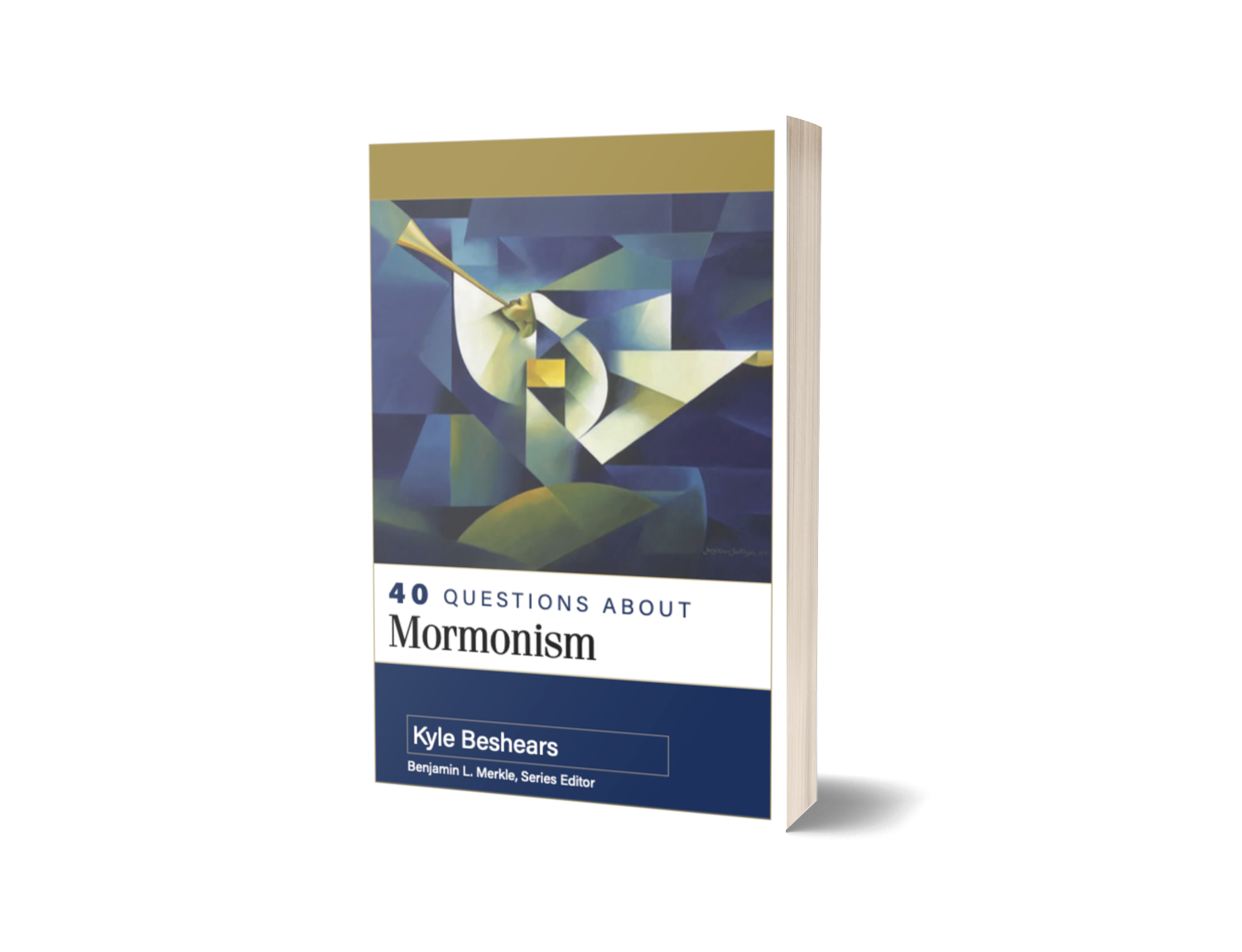
📘 40 Questions About Mormonism
If you’ve appreciated this essay, you’ll love 40 Questions About Mormonism (Kregel Academic). It’s written for traditional Christians who want clear, charitable, and biblically faithful answers to the most common questions about the Latter-day Saint faith and tradition.
The Latter-day Saint understanding of knowledge and revelation is much more neo-platonic than an Evangelical Christian might understand. The Church is a structure or framework that provides guidelines to individuals obtaining personal revelation. Its a hierarchical institution designed to mass-produce mystics. The church doesn't produce Thomas Aquinas, it produces Dionysius the Aeropagite. Systematizers get overruled by revelation. It's a real, persistent tension.