


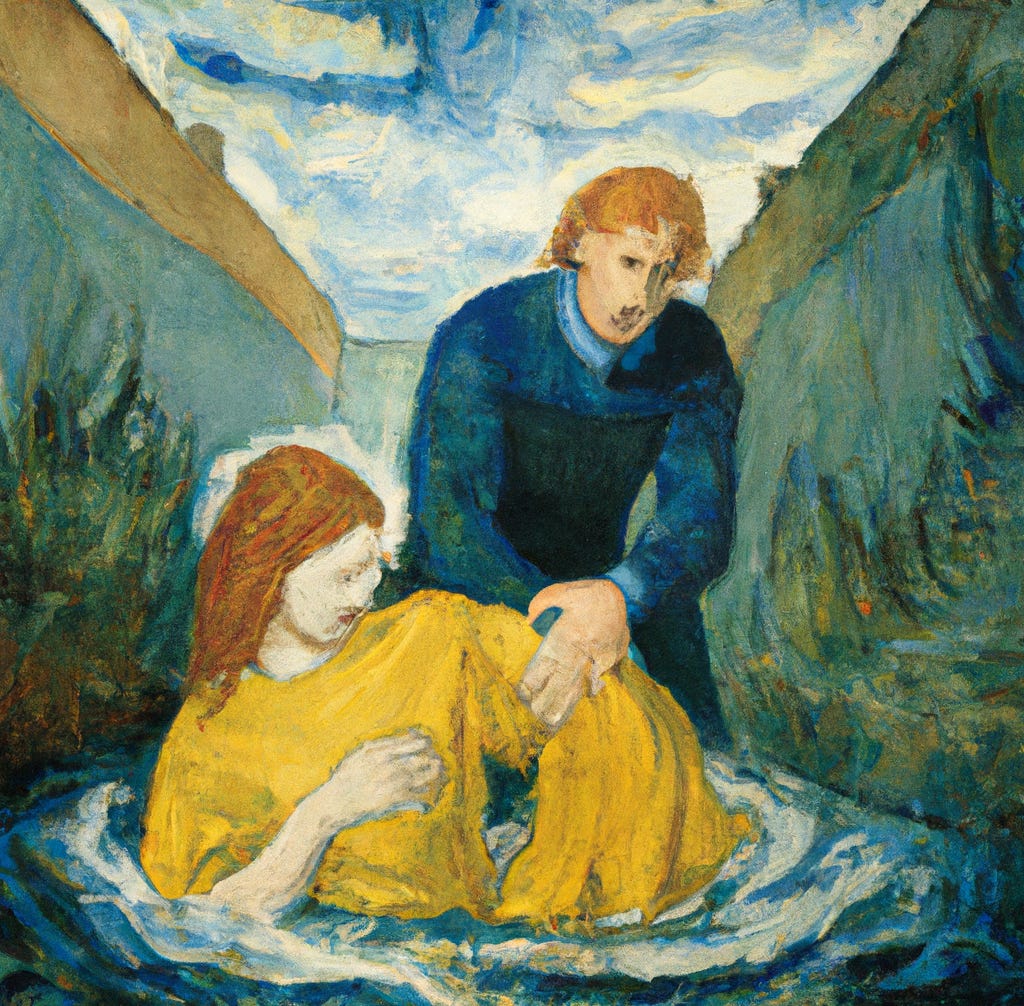
Jane Harper Neyman pinched her nose and clutched the elder’s arms as he dipped her beneath the surface of the Mississippi River in September 1840. This wasn’t her first baptism, and neither was it for her. She restirred the waters on behalf of her son, who died before having the chance to receive an ordinance so important to Latter-day Saints that entry into the celestial kingdom of God is prohibited without it. How, exactly, Neyman’s vicarious work would reach her son in the afterlife was then a mystery, but this was of little concern to her at that moment. Joseph Smith, her prophet, promised a month earlier that living members could be baptized on behalf of those closest to them “who had departed this life.” Should the departed choose to receive baptism in the hereafter, they would be saved not only to themselves but into an eternal family. Neyman wouldn’t just see her son again in heaven. They would be rejoined in familial kindship forever.
As the elder pulled Neyman up out of the water, she became the first known Latter-day Saint to be baptized on behalf of the dead, but certainly not the last. Today, countless deceased men, women, and children from around the globe and across time have been the subjects of proxy baptism by members of the Church of Jesus Christ of Latter-day Saints. So why, exactly, do Latter-day Saints baptize for the dead?
The Development of Proxy Baptism
Neyman wasn’t alone in losing a loved one they wished to see again one day. Joseph Smith was seventeen in 1823 when his beloved old brother, Alvin, perished unexpectedly. Nearly two decades later, Joseph still recalled the “pangs of sorrow that swelled my youthful bosom and almost burst my tender heart” after the loss. His grief was compounded by a minister who opined that Alvin was consigned to hell for belonging to the wrong church. But the early 1820s marked the dawn of Joseph’s restoration movement, and with it, new answers to old questions.
What is the fate of the dead who never had a chance to hear the gospel? This question inevitably arose after European Christians encountered indigenous people in the Americas. Clearly, they could not have heard the gospel in the many centuries following Christ’s resurrection. How could they? There were no Christians west of Greenland and the Azores prior to European exploration and colonization. But if “faith cometh by hearing, and hearing by the word of God,” (Rom. 10:17), why would a just God allow entire nations to be devoid of the gospel for so many generations?
The Book of Mormon answered this question, in part, at least for indigenous people. The American natives—Christ’s “other sheep,” according to the Book of Mormon (John 10:16; cf. 3 Nephi 15:21)—had, in fact, heard the gospel, but largely rejected it and, like their counterparts across the globe, sunk into apostasy. But what about people like Alvin who heard the Christian message but died prior to the restoration? We might call them the misevangelized, from Smith’s perspective. What is the fate of those trapped in sectarianism absent the kind of salvific ordinances that could secure celestial glory?
The Book of Mormon answered the question about the fate of the unevangelized across space. Now, Smith would need to answer the question about the fate of the misevangelized across time.
Smith’s answer began to take form in 1836 after he reported a visionary experience in which he “beheld the celestial kingdom of God.” The imagery was striking; the overwhelming “transcendent beauty” and “blasing throne of God” arrested Joseph’s attention until he saw something completely unexpected. Alvin was there, in full celestial glory. Joseph “marvled how it was that [Alvin] obtained this an inheritance in that kingdom.” After all, his brother died six years before the LDS Church organized, and with it, all the restored authority and rites Joseph taught were necessary for salvation. So, how could Alvin be in God’s presence without having received the latter-day gospel? God himself answered the question in the vision: “all who have died with[out] a knowledge of this gospel, who would have received it, if they had been permited to tarry, shall be heirs of the celestial kingdom of God.”
This vision fundamentally altered Smith’s view of the afterlife. He now denied that “the destiny of man is irretrievably fixed at his death,” but still wondered how, exactly, one’s eternal destiny might be altered if eternal destinations depend on hearing the gospel and responding through rites and ordinances in this life.
Protestants in Smith’s day generally rejected the possibility of a second chance or purgatorial state in the afterlife, grounding their belief in the plain reading of Hebrews 9:27, “And it is appointed unto men once to die, but after this the judgment.” In the absence of an explicit teaching on postmortem conversion in the Bible, this interpretation seems the likeliest to many Christians still today. The Book of Mormon, too, appears to leave little room for postmortem salvation, teaching that the days of our lives offer us a chance to “repent while in the flesh” (2 Nephi 2:21) since afterward we are consigned either to “paradise” (Alma 40:12; cf. 2 Nephi 9:10, Luke 23:43) to enjoy rest and peace while awaiting resurrection or to “outer darkness,” a hellish state where “there shall be weeping and wailing, and gnashing of teeth” (Alma 40:13; cf. Matt. 22:13).
But Smith thought “there are sins which may be forgiven in the world to come,” evidenced by Christ’s descent into death to preach to the spirits in prison (1 Pet. 3:18–20; 4:6) and to “bring them out of the prison house.” The unevangelized and misevangelized would, in fact, have the opportunity to hear Smith’s ‘restored’ gospel in the afterlife. Salvation awaited them, should they choose to accept it.
But what of baptism? Smith taught that baptism by a proper priesthood authority was necessary for entry into celestial glory. It’s one thing to offer the gospel message to post-mortem souls, but how can the dead be baptized to effect their positive reception of God’s invitation? They can’t, of course. Dead bodies cannot be baptized.
By August 1840, however, Smith publicly taught the solution for the first time. Smith cited 1 Corinthians 15:29, in which the apostle Paul wondered rhetorically, “Else what shall they do which are baptized for the dead, if the dead rise not at all? Why are they then baptized for the dead?” Smith explained how Paul “was talking to a people who understood baptism for the dead, for it was practiced among them.” He then invited people to practice proxy baptism “to save all who were willing to obey the requirements of the law of God,” one of which being baptism.
A month later, Neyman was the first to take him up, and in October, Smith clarified this new practice in a letter to his apostles. “The saints,” he explained, “have the priviledge of being baptized for those of their relatives who are dead, who they feel to believe would have embraced the gospel if they had been priviledged with hearing it,” particularly those who receive the gospel in the afterlife. In doing so, the Saints could expand their eternal kinship network and participate, in some mysterious way, as secondary ‘saviors’ of Christ for the dead.
Proxy baptism thus became a distinctive practice long before Smith’s letter to his apostles was canonized in 1976 (D&C 137). Today, the rite is performed exclusively in temple baptismal fonts supported by a host of genealogists whose research identifies deceased candidates for baptism. With each vicarious baptism performed, Latter-day Saints believe another person is offered the chance to join their kin in an ever-expanding community across dispensations of redemptive history.
Postmortem and Vicarious Salvation in Christianity
If Mormonism finds vicarious baptism critical to redemption, why do traditional Christians reject the practice? Simply put, in the absence of direct biblical teaching, most Christians do not believe an opportunity exists beyond the grave to alter one’s eternal destiny. When the Bible does speak vaguely or implicitly about an intermediary state prior to judgement (e.g., 1 Cor. 3:10–15), it is still silent on whether a soul can change their destiny. Instead, the Bible assumes the finality of destination after divine judgment (Matt. 25:31–46). Even the Roman Catholic doctrine of purgatory contends for an intermediary space reserved to purify those who “die in God’s grace and friendship,” not as an intermediate state capable of altering one’s eternal trajectory.
What, then, becomes of those who never hear the gospel? Theologians have traditionally proposed three categorical possibilities for the fate of the unevangelized, each with nuanced subcategories of their own. These three categories are particularism, inclusivism, and pluralism.
Particularism maintains that saving faith in Jesus Christ may only come by means of hearing and responding to the gospel or special revelation from God. Inclusivism sees saving faith possible through general revelation given by God through myriad ways. Pluralism believes God honors alternative religious paths to his saving presence. Christianity largely rejects universalism—the belief that eventually all are saved—especially given the hermeneutical weight behind NT teachings on the eternality of life in Christ or death apart from Him (Matt. 12:32; 18:6–8; 2 Thess. 1:8–9; Rev. 20:13–15). And even though the LDS theology of heaven secures room for nearly every child of God, an eternal state of outer darkness still awaits the most obstinately wicked and unrepentant (Alma 40:13–14; cf. 2 Nephi 10:23; Jacob 6:8–10). An absolute religious pluralism, too, is blunted in both traditional Christian and LDS soteriologies because, in the end, it is the particularity of Jesus Christ’s atonement (i.e., his unique work alone) that crowns God’s redemptive plan for the world.
In the end, Christianity is less interested in the possibility of a postmortem reception of the gospel because of the Bible’s emphasis on premortal election (Eph. 1:3–6; Rom. 8:28–30) and the necessity of belief in Christ’s resurrection and confession of His lordship in the present life (Rom. 10:9), to be “born again” before we die again (John 3:3; Rev. 20:14). It follows that if eternal destinies are fixed after death, there is no need for proxy baptism (and, from a Protestant perspective, even less so considering sola fide).
But what of that enigmatic verse from 1 Corinthians? Did Paul endorse vicarious baptism for the dead, and, if so, it is a lost practice from the ancient church that ought to be restored?
Vicarious Baptism in the New Testament
Admittedly, this verse is difficult to interpret. Why the Corinthian church practiced baptism for the dead is perplexing. No other biblical passages support the practice, a fact evidenced by the early church’s eventual dismissal of it. Biblical scholars have made numerous unsuccessful attempts to pull the hermeneutical sword from this exegetical stone. Gordon Fee is right to point out that “when there is such a wide divergence of opinion, no one knows what in fact is going on.” So, Craig Blomberg’s advice here is sage: given the array of interpretations, “we dare not be dogmatic in upholding any one of them.”
Perhaps the better question to ask is why the Corinthian church—not the church universal—baptized on behalf of the dead? First, the context. Paul was troubled by some members of the Corinthian congregation who, having accepted his full gospel, later denied a critical element of it: the resurrection (1 Cor. 15:12). If there is no resurrection, Paul argued, then “your faith is vain” (1 Cor. 15:17). He asked rhetorically why “they”—some in the congregation or in the church’s proximity—baptized for the dead to prove his point (1 Cor. 15:29). Whatever the apostle meant by this, one thing is clear: “Paul’s theological shorthand here made clearer sense to the Corinthians than it does to us.”
It’s equally clear, though, that his concern isn’t vicarious baptism per se but the meaninglessness of any baptism whatsoever—whether it’s for the living or the dead—if the promise of resurrection is hallow. After all, the apostle elsewhere argued, “we are buried with [Christ] by baptism into death” so that just as Christ rose from death, “even so we also should walk in newness of life” (Rom. 6:4; cf. Col. 2:12). A crucial purpose for baptism is to rehearse today what God has promised for tomorrow—life beyond the grave.
This explanation is about as far as the verse may be taken. Paul does not seem particularly bothered by vicarious baptism but neither does he affirm it. He’s far more interested in the bigger picture: not baptism for the dead but resurrection of the dead. By emphasizing resurrection over baptism, Paul reminds us that an ordinance is far less important than the thing it represents. In the end, the eternally blessed are those whom God ushers into His celestial presence—who “enter the city by the gates” (Rev. 22:14, ESV)—with cleansed robes, not having washed their souls by water but having “washed their robes and made them white in the blood of the Lamb” (Rev. 7:14, ESV).
The print edition will, naturally, include citations.
Thanks for joining me on my journey of authoring 40 Questions About Mormonism (Kregel Academic). If you enjoyed this post, please, share it and invite your friends to join in.
Full transparency: I don’t make money off this newsletter, but I do want to make this book the best that it can be. If you have feedback, let me hear it.
Email me at hello@kylebeshears.com or DM me on Twitter @kylebeshears.