


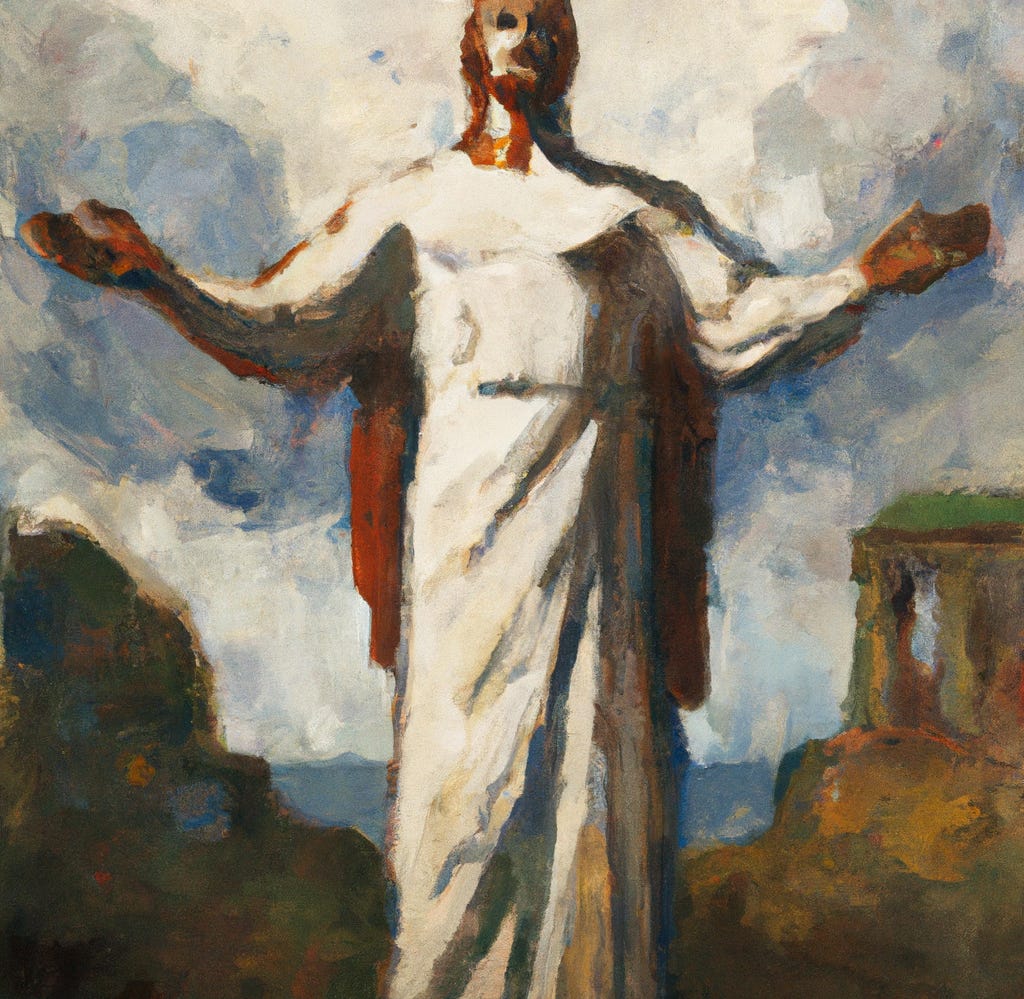
When Jesus asked Peter, “Whom do men say that I the Son of man am?” his question probed the heart of God’s redemptive work (Matt. 16:13). Answering incorrectly risks assigning Jesus the role of a mere prophet or moral teacher in the long tradition of God’s representatives to Israel. So it was for those who equated Jesus to John the Baptist, Elijah, or “one of the prophets” (Matt. 16:14). To answer correctly, though, as Peter did, was to recognize that not only had God sent his chosen messiah to secure our redemption, but that the God of heaven himself was dwelling among us on earth, our Immanuel. “Thou are the Christ,” confessed Peter, “the Son of the living God” (Matt. 16:16).
An early LDS revelation echoed Peter’s confession, declaring that “Jesus Christ [is] the Son of the living God,” and signaling Joseph Smith’s intent for his future church. The Son would play the central role in what would become The Church of Jesus Christ of Latter-day Saints. Yet, as the revelation continued, it also promised the imminent restoration of “the fulness of [Christ’s] gospel,” suggesting that the church he promised to build on Peter’s confession was then somehow incomplete (Matt. 16:18). There was something missing in our knowledge about the person and work of Christ. For this reason, Mormonism presents a Jesus that is simultaneously familiar and foreign to traditional Christians.
To say that Latter-day Saints worship an utterly different Jesus is, at once, rashly uncharitable, and yet precisely true. On the one hand, it cannot be said that LDS theology teaches a Jesus who is totally foreign to the Christ of Christianity and completely devoid of any similarities whatsoever. Mormonism affirms that Jesus Christ was truly human, born of the Virgin Mary and raised in Nazareth. He gathered twelve disciples, performed miracles, and preached repentance. He lived sinlessly, setting the ultimate example for holiness and human flourishing. The object of his life-giving ministry was paradoxically his sacrificial death for the atonement of sin. After three days in the tomb, He was raised bodily and ascended to the Father, where he awaits his return to judge the living and the dead. Non-Mormon readers may be surprised to learn that all these descriptions of Jesus come from the Book of Mormon, the main character of which is the Son of God.
One the other hand, LDS theology irreversibly departs from traditional Christianity when it claims that Jesus is literally the Son of God, the firstborn child of the Father and our eldest spirit brother, whose membership in the Godhead is not timeless but began after his ascent to godhood via personal progression. These differences are very serious and overshadow every shared conviction between Christianity and Mormonism about the nature of the Son of God. So, who is Jesus Christ according to Mormonism? To answer this question, we will consider two fundamental areas of disagreement: the nature of the Son and his relationship to the Father.
Christ’s Nature According to Traditional Christianity
Jesus was truly human. Like all people, he grew up as a child, increasing “in wisdom and stature” (Luke 2:52). He traveled by foot, ate meals, and got sleepy. He cried with his friends when one from among them died. Sometimes, he needed a break from the crowd, so he retreated for solitary rest. Jesus was even “in all points tempted like as we are, yet without sin” (Heb. 4:15). Christ’s humanity was never in question during the NT period. Instead, the earliest Christians were awestruck by His claim to deity. How could a human man, as great as he is, also be God? It’s one thing to wonder “can there any good thing come out of Nazareth” (John 1:46), but could God come from Nazareth, too?
The path to answering this question was long and winding, lasting over centuries and, at times, veered dangerously close to heresies that either refused to acknowledge Christ’s full deity (e.g., Ebionism and Arianism), or oppositely, accented his deity so loudly that his humanity was drowned out (e.g., Docetism and Apollinarianism). Erring here devastates Peter’s confession that Jesus is both the divine Son of God and messiah from among men. As Leo the Great contended, there is “equal danger in believing the Lord Jesus Christ to be God only and not man also, or man only and not God,” because he would forfeit his unique role as mediator between both.
Of particular importance to the early church was how it understood the deity of the Son and his relationship to the Father. A fourth-century council in Nicaea clarified the both/and reality of the Son as both a distinct person from the Father and of the same essence with the Father (homoousios). The Son is not merely like the Father; instead, the Father and the Son share the same being so that they are “consubstantial,” sharing every attribute that is essential to God.
Tertullian likened this relationship to a natural spring that produces a river. Both are made of the same thing (i.e., water) but they are nevertheless distinguishable from each other as a spring is from a river. So it is with the Father and Son, who share the same essence and yet are distinctly identifiable persons. As the Gospel of John declares, “the Word was with God, and the Word was God,” (John 1:1), and this Word, the eternal Logos of God, mysteriously “became flesh and dwelt among us” (John 1:14).
Thus, while the immutable Son of God (who shares all attributes with his Father) is an unmoved Mover, Jesus of Nazareth is our most moved Messiah, one who shared in the human experience for our redemption and God’s glory. This is a paradox, a great mystery that cannot be fully comprehended, only received by faith. Appealing to mystery here is not a copout but a confession, a recognition that our finite understanding can only take us so far until all we can do is worship the sheer grandeur of the Lord Jesus Christ.
So, why did early Christians come to these conclusions? The Bible consistently forbids creaturely association with the Creator. No attribute of God may be attributed to anything or anyone besides God, nor may they share in his works, name, or worship. To associate God’s name and work with anything is to equate it with his divine nature.
It’s shocking, then, for the earliest Christians—mainly monotheistic Jewish converts—to believe what they did about Christ. Jesus is one in whom “dwelleth all the fulness of the Godhead bodily” (Col. 2:9). He is the one through whom all things were created (John 1:3; Col. 1:16–17). Christ sustains the cosmos by presently “upholding all things by the power of his word” (Heb. 1:3; cf. Rom 11:36; Col. 1:15–19). Like God, Jesus is called Lord, Holy One, Savior, and even shares in the holiest name of God, yhwh, but is mysteriously distinct from him (Exod. 3:14; John 8:58; cf. John 1:1). God’s name and redemptive work collide in Jesus when the apostle Paul promises “whosoever shall call upon the name of the Lord shall be saved” (Romans 10:13). Here, Paul attributes to Christ what Joel first attributed to yhwh (Joel 2:32). No wonder Jesus not only directs worship to himself but also receives it (John 5:22–23; 20:27–29; Rev. 5:11–12). The Son of God is the immutable creator who was made flesh, died for the forgiveness of sins, and is “the firstborn from the dead” (Col. 1:18), i.e., the first among many to resurrect into eternal life.
While Mormonism shares many of these same convictions, it also teaches that Jesus Christ is literally the firstborn son of God, who ascended to his glorified position within the Godhead. From a traditional Christian perspective, then, it is more useful to ask why, rather than whether, Mormonism affirms the deity of Christ.
Christ’s Nature According to Mormonism
In Mormon thought, Jesus Christ is the “Firstborn of the Father,” an instinctually familiar title to Christians but one that carries with it different meaning. The Bible frequently uses the plain meaning of “firstborn” to describe order of birth, while at other times, the “firstborn” indicates a unique status with God (Exod. 4:22; Psalm 89:20, 27–29; Jer. 31:9). It is in this second sense, for example, that Christ is understood to be the “firstborn” of creation, preeminent over the universe (Col. 1:15), and the “firstborn” among those who would share in his resurrection (Rom. 8:29).
When applied to Christ, Mormonism interprets “firstborn” in both senses simultaneously. As one LDS theologian explained, “Jesus was the firstborn spirit child of God the Father and thus the recipient of the birthright of the royal family.” Jesus, then, is the “Only Begotten” Son of the Father who became so—but was not always so—by virtue of being born first and achieving exaltation prior to us, his spiritual younger siblings, who receive glorified states through our ‘elder brother.’ Thus, the glorified nature of the Son is not eternal (having no beginning), and neither is his membership in the Godhead. Instead, the Son joined his Father, elohim, as his divine counsel, becoming yhwh, “the Great Jehovah of the Old Testament,” the creator of this cosmos and object of our worship. And in his subordinated status, the Son, having learned about God’s past redemptive work (i.e., death and resurrection), emulated his Father because, as Christ taught, “the Son can do nothing of himself, but what he seeth the Father do” (John 5:19).
LDS Christology, then, departs significantly from traditional Christology. While Christians traditionally believe the Son to be eternally homoousion (same-in-essence) with the Father, Mormonism understands the Son to be homoiousion (similar-in-essence) with the Father. They are essentially of the same species of being but do not share the same being. The LDS position genuinely appreciates the holy grandeur of the Son’s nature apart from the cosmos he created (contra Ebionism or Arianism) but cannot acknowledge the Son’s timeless and immediate sharing in God’s glorious nature. The Son is very much like God but lacks eternal equality with God. To recall Tertullian’s imagery, sometime in eternity past, the Father was a river-less spring.
For traditional Christians, then, LDS Christology teaches a Jesus that is not eternally God, and, if so, he is not truly God. He is only ever a God-like being who became so. It is true that Mormonism teaches an eternality to the Son, owing to Smith’s teaching that the only uncreated things are minds and their ideas, or “intelligence,” from which all rational beings ultimately originate. As with the Father, the Son is, in a sense, eternal insofar as his intelligence is without beginning or end. But so are all intelligences for that matter; every reader of this post is co-eternal with God in this sense. (More on this in a subsequent post.)
What is at issue is not whether the Son had some ideal preexistence that He shared with other intelligences but if His preexistence was real and personal. To affirm the latter is to confess that His divine nature is uncreated and timeless. And while Christianity affirms with the Bible that Jesus is the only begotten Son of God, it understands this title to mean that the Father is eternally the Son’s Father, not by sourcing the Son’s essence, but by mutual loving relationship that communicates essence. As Augustine explained, the Father did not at some point in time begin to beget the Son, for “the life which the Father gave to the Son by begetting is co-eternal with the life of the Father who gave.”
So, why does this matter in the end? One’s understand of the nature of Jesus underpins Peter’s salvific confession, “Thou are the Christ, the Son of the living God” (Matt. 16:16). And as Jesus taught elsewhere, “he that seeth me seeth him that sent me” (John 12:45). To know God, then, is to know the Son of God. So, who do we see when we look at Jesus Christ; the eternal Son of God himself or a generated Son from God? The answer to this question is not trivial, for when we see the Son truly, Jesus says, we are actually seeing the living God truly, too.
Note: Perhaps you’re now wondering about the work of Jesus Christ after such a lengthy discussion on his person. Christ’s atonement and resurrection will be discussed in later posts.
Thanks for joining me on my journey of authoring 40 Questions About Mormonism (Kregel Academic). If you enjoyed this post, please, share it and invite your friends to join in.
Full transparency: I don’t make money off this newsletter, but I do want to make this book the best that it can be. If you have feedback, let me hear it.
Email me at hello@kylebeshears.com or DM me on Twitter @kylebeshears.
As a latter day saint it take issue with this "While Mormonism shares many of these same convictions, it also teaches that Jesus Christ is literally the firstborn son of God, who ascended to his glorified position within the Godhead.".
Not that there are no Latter-day Saints who hold this position, but at least I do not. The Book of Mormon on it's very title page says one of its main purposes is to the convincing of all that Jesus is the Christ, "the Eternal God". So the more natural conclusion from the Book of Mormon is that Jesus is eternally God. If you have an something that is actually canonical to us, I would be curious to see it, my memory is not perfect of course. If you haven't read it yet the 1918 official first presidency declaration "The Father and the Son" if you are trying to be intellectually honest this is a better Latter-Day saint position to interact with then anything that is non-canonical.
I wish you well, one of the less terrible evangelical discussions for sure, good job.
https://www.churchofjesuschrist.org/study/ensign/2002/04/the-father-and-the-son?lang=eng