



Note: This essay is descriptive, not participatory. I’m writing as an observer, not necessarily a voice from within.
You’ve heard of the “counter-cult” movement, I’m sure.
It was a fixture of mid-20th century evangelicalism, a broadly defensive posture aimed at protecting Christians from groups deemed to teach heterodoxy and heresies. Mormonism, Jehovah’s Witnesses, Christian Science, Freemasonry, and myriad occult movements were all lumped together as targets. The goal was doctrinal inoculation, to build just enough literacy to draw intuitive boundaries and prevent evangelicals from converting.
In large measure, it succeeded. I still hear echoes of it today.
But I do mean echoes.
I think it’s apparent that the “counter-cult” movement has largely faded. Evangelical attention to the “cults” hasn’t, though. It’s returned in a new form, one I’ve started calling the contra-cult movement: a decentralized, entrepreneurial, and often digital form of evangelical engagement with religious groups historically labeled “cults” (e.g., Mormonism, Jehovah’s Witnesses).
Notice the prefix change, from counter- to contra-.
Unlike the mid-20th century counter-cult movement—which aimed to protect evangelicals from heterodox groups through avoidance and inoculation—the contra-cult movement is characterized by an offensive posture: public-facing, algorithmically distributed content aimed at members of those groups. It operates without central authority, credentialing institutions, or canonical texts, relying instead on the dynamics of the digital age. Even if the interactions are in-person, they are recorded and uploaded for digital consumption.
So, what’s changed is not that engagement happens but how. In the last century, we’ve seen at least three distinct phases: the classic counter-cult movement, the momentary post-9/11 turn toward Islam, and the emerging contra-cult landscape. Each phase reflects the anxieties, media habits, and cultural pressures of its moment. The newest phase is no exception.
I’ll sketch the earlier two movements briefly before focusing on what’s taking shape now. My hope is to caution against repeating old patterns as evangelical engagement becomes increasingly digital and democratized.
Phase One: The Counter-Cult Movement
The counter-cult movement emerged in twentieth century and matured through the late twentieth century. Walter Martin’s Kingdom of the Cults became the reference text. Ministries, conferences, and publishers built infrastructure around a single task: protecting evangelicals from doctrinal drift. This defensive posture gained particular urgency during the Cold War, when many American evangelicals believed that Christian hegemony and purity kept Communism at bay. Protecting the flock from cults was, thus, both a pastoral and patriotic duty.
The best way to do so was, apparently, was to inform and discourage engagement. So, the audience wasn’t the heterodox group itself but the evangelical sitting in the pew. A key verse was 2 John 1:10-11: “If anyone comes to you and does not bring this teaching, do not take them into your house or welcome them.” The posture was avoidance, not engagement.
I first learned about Mormonism because my church library stocked counter-cult materials and showed my youth group The God Makers. Like many evangelicals in that era, my initial awareness came from books and films designed to inoculate rather than inform. True, it gave me basic orientation to religious movements I’d never encounter otherwise—it wasn’t until my early 20s that I met a real live, bona fide Latter-day Saint—but it also meant my first impressions were shaped by uneven accuracy in wildly variable tones. Mormons, for example, were dupes and deceived. Best to stay away, unless you want to becoming like them. That being the case, I think the movement sometimes confused doctrinal disagreement with moral panic.
Still, it represented a coherent attempt to help evangelicals navigate nearby religious worlds, so I’m grateful for that. It assumed theological disagreement matters, and it does, so discernment is important, which it is. I just lament the fact that the counter-cult movement too often—at least as I’ve seen—instilled more suspicious fear of neighbor than genuine love for them.
You can read more about my thoughts on this here.
Phase Two: The Post-9/11 Turn Toward Islam
The second phase wasn’t an evolution so much as a redirection. After September 11, Islam replaced the “cults” as the primary religious concern in conservative evangelical discourse. The shift didn’t arise from doctrinal anxiety—I never met more than a handful of evangelicals who genuinly feared mass conversion to Islam. The anxiety was more about global politics and renewed debates about religion and national identity.
Engagement with Islam, then, was framed through geopolitics more than theology. Evangelicals who once worried about Jehovah’s Witness literature at their door suddenly worried about civilizational conflict. And we weren’t prepared of the sudden change, so we scrambled for guidance and got so-called “experts” like Ergun Caner, i.e., someone who claimed authority he didn’t have and was later exposed for making up elements of his testimony. Essentially, he filled an urgent need for evangelicals, and he said what we wanted to hear—he tickled our itching ears about the evils of Muslims. Eventually, we got more careful voices, but we started off on the wrong foot, for sure.
One of the unintended consequences of this momentary shift of attention was the atrophy of the counter-cult movement. The books stayed in print but weren’t replaced and only lightly revised, which is why evangelical apologetics in this area can taste so stale. You were more likely to hear a talk on Islam than Scientology at evangelical conferences. Unveiling Islam supplanted exposes on Mormonism. By the time the War on Terror wound down—troops drawn down in Iraq, ISIS collapsed, troops withdrew from Afghanistan, etc—two decades had passed. So, when evangelical attention finally returned to “cults” in the early 2020s, the landscape had changed completely.
Phase Three: The Rise of the Contra-Cult Movement
Within the last few years, evangelical attention has returned to the religious movements once labeled “cults,” but the form of engagement looks nothing like the world of Walter Martin. The contra-cult movement is public-facing, digital, and overwhelmingly decentralized. It thrives in algorithmic environments where anyone with a phone can become an interpreter, critic, or commentator on groups like Mormonism, Jehovah’s Witnesses, or Scientology.
I’ll focus on Mormonism for the rest of the essay, because that’s what I’m most familiar with.
What caused the change? I think there’s a bunch of reasons.
The COVID lockdowns, for starters, accelerated our online content consumption. Limited series like Under the Banner of Heaven and Keep Sweet: Pray and Obey brought “cults” into the public imagination in a way they hadn’t been prior to. The deconstruction movement made ex-member stories into consumable podcast series. In the 1990s, if you wanted to hear a Mormon de-conversion story, you’d have to fly to Utah. Today, TikTok and YouTube’s recommendation engines have learned that religious controversy drives engagement, so it’s just a matter of scrolling.
There’s also a generational dimension. Millennial Evangelicals and younger aren’t inspired by the “stay away” posture of the counter-cult movement. They’re not naive about heterodoxy—they know theological boundaries matter—but they’re instinctively resistant to Othering. The impulse to stick up for the outsider runs deep in this cohort. The counter-cult’s protective crouch just doesn’t resonate. It feels fearful rather than faithful. I’ve seen this at apologetics seminars: classic counter-cultists doing their thing but not connecting with Gen Z. And the old tactics don’t work anymore. The “expert” says something salacious about a “cult,” and within five seconds the audience is fact-checking with AI on their phones. The old posture and its infrastructure has lost its power, but some of the counter-cult folks haven’t picked up on that yet.
(Side note: in my opinion, the “cult” label itself still carries latent permission to be unserious. Personally, I reserve the term for groups that fit the sociological profile—small, high-control, leader-centered movements like Jonestown or NXIVM—rather than large religious traditions with developed theologies, however much I may disagree with them.)
Then, there’s what I’ll call the Mormon proximity problem. Latter-day Saints aren’t showing up online as fringe figures but as attractive, successful, wholesome content creators, e.g., Mormon mommy influencers, BYU athletes, successful musicians, etc. At the same time, the LDS Church has pivoted away from “Mormonism” by emphasizing Christ-centered language and adopting rhetoric that sounds increasingly evangelical. The old markers of difference are harder to spot.
Granted, the Church’s recent legal action against use of the term “Mormon” complicates this effort. It’s sending mixed messages, and, in my opinion, the Church needs to settle it’s relationship with “Mormon”: either give it up or retain it in some form, but don’t distance from it—especially by assigning a negative moral quality to it—only to then sue people for using the word. It’s super confusing.
Anyway, for Latter-day Saints, this shift represents a sincere effort to emphasize their faith in Christ, but it feels very different for evangelicals. For us, it re-raises questions about where theological boundaries lie. Mormons aren’t distant anymore; now, they’re our algorithmic neighbors.
Naturally, that proximity elicits a response.
But unlike the counter-cult movement—which rallied around recognizable experts—the contra-cult movement has no central authority, no stabilizing reference point, and no go-to texts. Instead, we see a flattened ecosystem: reaction channels analyzing Mormon temple ceremonies, street evangelism videos on YouTube, ex-member testimonies on TikTok, long-form interview podcasts, self-published exposés, etc. Some are theologically informed, others experientially driven. Many are both.
This parallels what Carl Trueman calls ‘Gig Eva,’ which is his term for the gig-economy model of evangelical influence, where entrepreneurial authority replaces institutional gatekeeping. Because the medium rewards personality and visibility, influence depends less on scholarship than on the dynamics of digital attention.
The audience has shifted, too. Counter-cult material was produced for evangelicals to consume privately. Contra-cult content is public-facing and aimed at a dual audience. The posture isn’t “stay away” but “prepare and engage.” The banner verse isn’t 2 John 1:10–11 anymore; it’s closer to 1 Peter 3:15: “Always be prepared to give an answer,” though we might remember that the same verse demands we do so ‘with gentleness and respect.’ (I’ve seen this done very well very recently, but I’m also seeing it done poorly.) Evangelicals aren’t just learning about Mormonism in their church Bible studies anymore. They’re performing—in the best sense of the word—their engagement with it for everyone to see.
Now, I think this democratization brings benefits. I’m especially grateful for the breaking of the ‘expert’ discourse monopoly. Those days are over, and good riddance. Evangelicals can now police their own with much more force.
For example, when Mark Driscoll released a sloppy booklet on Mormonism complete with an AI-hallucinated quote, he got called out publicly and deleted the resource rather than fix it. There’s no hiding behind the print-and-lectern circuit of the 1960s, when audiences assumed your expertise and wanted what you said to be true. Now, however, you get fact-checked in real time.
But that same democratization brings its own risks. Driscoll’s deletion, for example, doesn’t mean the work never happened, or that people who downloaded it stopped circulating it. And for every resource that gets called out, like the hydra serpent, dozens more circulate without scrutiny, because expertise has thinned and accuracy is harder to referee. Social media platforms reward spectacle over substance, and that’s a serious problem.
Again, the “cult” label itself is problematic, in part because it carries latent permission to be unserious. The attitude I sense is something like this: “You don’t really need to have all the facts straight with Mormanism [sic] because it’s so ridiculous: Why take it seriously?” So, even when engagement can be more charitable than it was in the counter-cult era, that framing also excuses laziness. If they’re a cult, the thinking goes, why engage their arguments carefully?
So, I see both promise and danger. The promise is that evangelical engagement can become more informed and humane, even more honest than some counter-cult material of the past. But the danger is that we risk repeating the errors of that earlier movement—e.g., caricature, haste, selective representation—while adding new problems that are made possible only by the social media ‘attention economy.’ And I’m still not comfortable with applying the term “cult” to groups like the LDS Church, although I doubt that’s going to change anytime soon, thus: countra-cult movement.
Anyway, the question is whether the countra-cult movement will become a more thoughtful form of religious engagement or another digital arena where complex traditions are flattened into content. The answer will depend on whether those who participate choose depth, accuracy, and clarity over the platforms’ demand for immediacy.

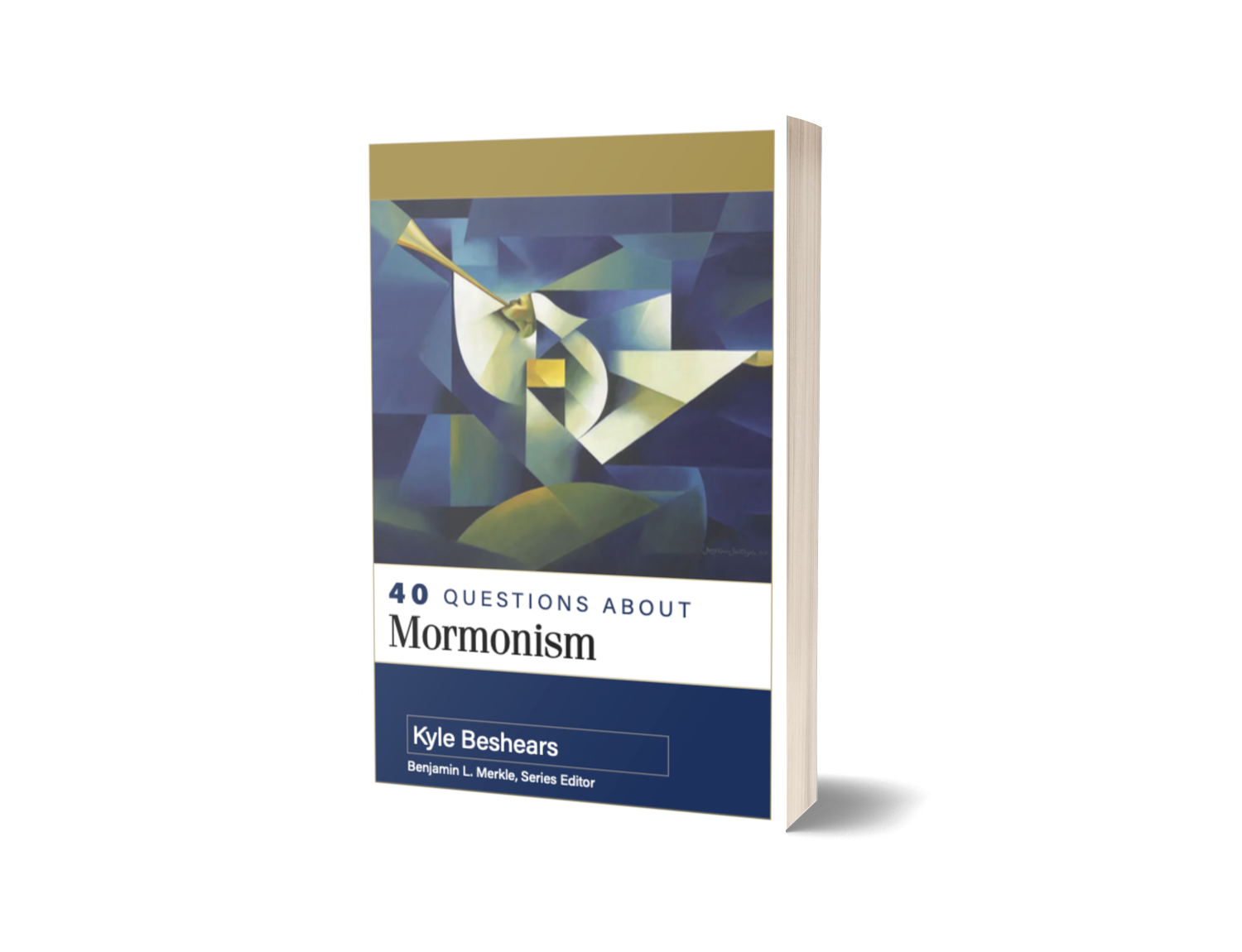
📘 Coming February 2026: 40 Questions About Mormonism
If you’ve appreciated this essay, you’ll love my forthcoming book, 40 Questions About Mormonism (Kregel Academic). It’s written for traditional Christians who want clear, charitable, and biblically faithful answers to the most common questions about the Latter-day Saint faith and tradition.
PRE-ORDER TODAY and download three free chapters while you wait.
Thanks for this post, and for inviting participation in it. I was a countercult insider in the late 1980s and exited not long after 9/11. I worked for various apologetics organizations, the best known being Watchman Fellowship, and was on the board for the umbrella organization Evangelical Ministries to New Religions.
I think your description and analysis is largely accurate, but I would quibble on some of the details. In Phase One, while there was a strong emphasis on avoidance or boundary maintenance, the movement also had a strong sense of engagement, often, in my thinking, confusing apologetic boundary maintenance with evangelism. You are quite correct that the warning of the dangers of "the cults" was a form of moral panic. I still remember one of Walter Martin's recorded sermons where he said he felt like Paul Revere warning "the cults are coming!" This indeed was based more on fear and defensiveness rather than love, but again, insiders felt the loving response was to engage in methods that led to insider vs. outsider stances.
There was also vigorous internal debate in the late 1990s and early 2000s related to the suggestion that the countercult might learn something from the critique of scholars like Gordon Melton and Douglas Cowan, as well as lessons that might be learned from missiology where "cults" might be more profitably be understood and related to as cultures or subcultures. The scholars were dismissed as "cult apologists," and countercult members felt they were already doing missions, which was little more than apologetic boundary maintenance done in the name of missiology. The results was a fracture in the movement, which led to the departure of figures like me to pursue my own pathway.
I remember what you call Phase Two when some in Watchman Fellowship suggested that the organization broaden its focus beyond the traditional Mormonism, Jehovah's Witnesses and New Age to also look at Islam. That was strongly resisted, but you are correct that the countercult and other apologetics ministries did respond to this, largely in a war of cultures approach that misunderstood broader Islam. This echoed sentiments in broader evangelicalism, discussed by Richard Cimino's great article "'No God in Common:' American Evangelical Discourse on Islam After 9/11." He documents the shift in perceptions and approach from Islam as a mission field to Islam as political and civilizational enemy, a stance that remains in our current political climate.
A few other thoughts. The countercult movement has always been decentralized. While it did benefit from a few leading voices and texts, it has tended to function as a host of independent "experts," many former members of various new religions, where past experience is assumed to equate with expertise in a tradition or a variety of traditions.
On the use of the term "cult," I've argued for decades that evangelicals should follow the lead of scholars of new religions who find the term ill-defined, pejorative, and counterproductive. Not only does it lend itself to casual dismissal of those groups to whom it is applied, it also says more about the user than a given group, in my view.
As to what you term the "contra-cult," this seems to be the next step and outgrowth of previous developments. Like its phase predecessors, I view it as ill prepared and culturally naive, functioning yet again as a form of apologetic boundary maintenance that functions more for faith confirmation while providing a sense of meaning for the contra-cult member and their audience rather than potentially persuasive and culturally relevant engagement.
The 'verbicide' of the word cult has done immense metaphysical and CULTural damage to society, let alone apologetics, evangelism, and inter-religious dialogue.