


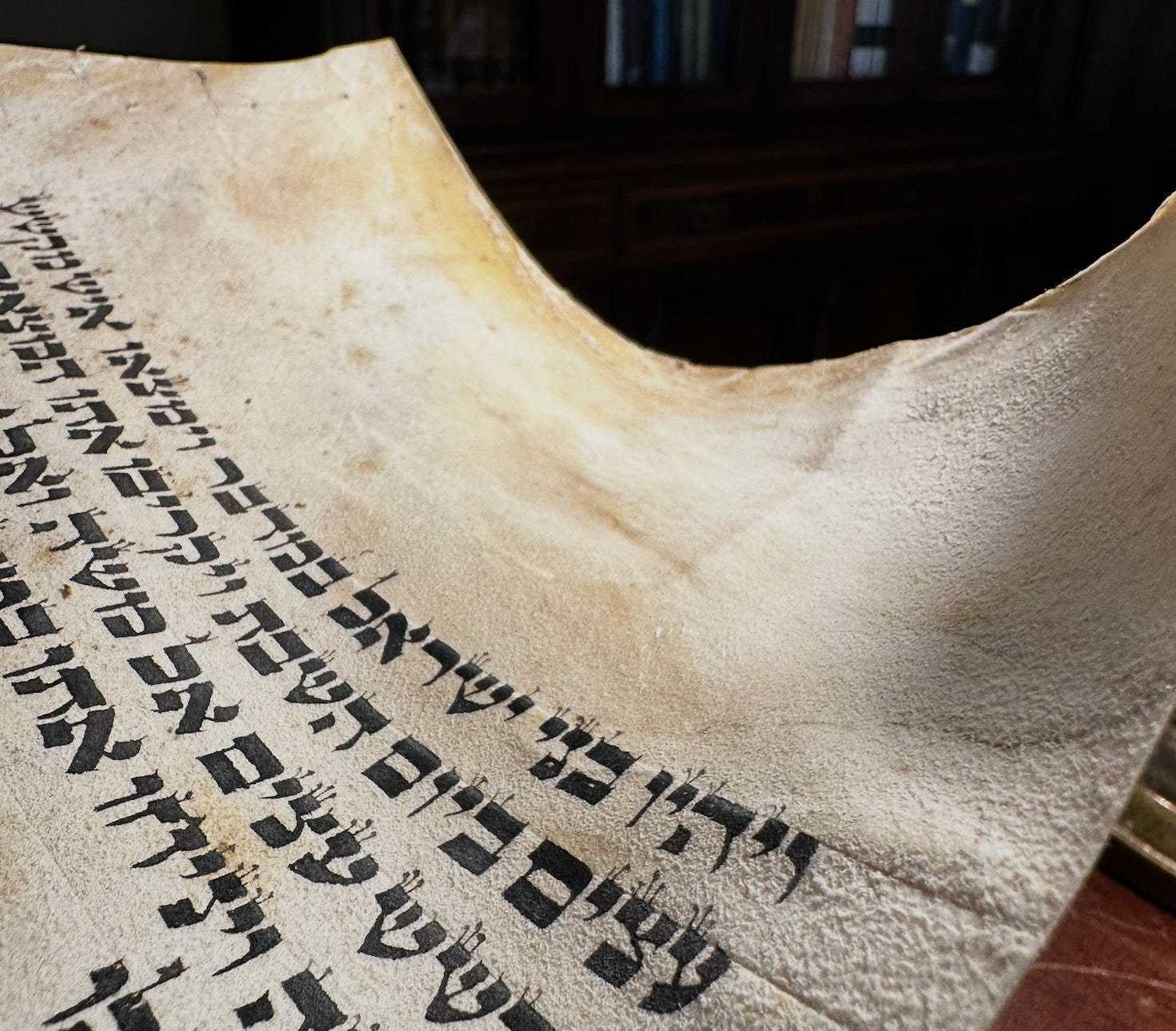
From a Torah scroll leaf containing Numbers 15:32–16:31. This leaf was gifted to me by a friend years ago.
Mark Twain once quipped that if Joseph Smith had left out “and it came to pass,” the Book of Mormon “would have been only a pamphlet.” It’s not quite that extreme, but I get why he said it. In the first edition, published in 1830, the phrase appears (I believe) over 1,000 times. “And it came to pass is,” to put it mildly, “annoyingly pervasive.”1
But what’s this phrase actually doing? And does the Book of Mormon use it the way the Bible does?
My attention was recently drawn back to the Book of Mormon’s pervasive “and it came to pass” after stumbling upon an interesting book by a Hebrew scholar from Yale Divinity School, Joel Baden, called Lost in Translation.
In it, Baden calls “and it came to pass” a classic case of “Bible-ese,” language that has “fallen out of use almost entirely, except in the Bible or in texts that are trying to sound old-fashioned or fancy.”2 According to him, the KJV’s “and it came to pass” is essentially a dressed-up rendering of way’hi, a Hebrew form of the verb “to be.” The translators saw a subjectless verb, supplied the generic “it,” rendered the waw as the conventional “and,” and then, as Baden puts it, “basically fancied it up” to get “and it came to pass.”3
But the phrase isn’t necessary in English. When “and it came to pass” appears in the KJV, it introduces a temporal clause, or a “when” clause. The function of way'hi is to signal that everything following it comes later, or afterwards. It’s like a timestamp. KJV translators, for whatever reason, chose to preserve that construction. Modern translations, like the NIV and NRSV, make a different call, and omit “and it came to pass” entirely, putting the temporal clause in past tense, and then move on.
So, we have:
“And it came to pass, as Aaron spake unto the whole congregation of the children of Israel, that they looked toward the wilderness, and, behold, the glory of the Lord appeared in the cloud.” - Exodus 16:10, KJV
or
“And as soon as Aaron spoke to the whole congregation of the people of Israel, they looked toward the wilderness, and behold, the glory of the Lord appeared in the cloud.” - Exodus 16:10, ESV
All you need to do is drop “and it came to pass” (and the accompanying “that”), and voila.
Which leads me back to the Book of Mormon.
I’ve read LDS scholars who point to “and it came to pass” as evidence of the Book of Mormon’s ancient Semitic origins, noting its resemblance to the Hebrew way’hi. But Baden’s analysis raises an interesting question: Does the Book of Mormon actually use the phrase the way Hebrew does?
In 1 Nephi 12, for example, the phrase “and it came to pass” is used five times in a row to move the narrative along. (I chose this passage because there are many “and it came to pass”es back-to-back, but the pattern I’m about to describe appears throughout the Book of Mormon.) These phrases, according to Baden, are apparently unnecessary, given that English doesn’t need a sentence-opening tense marker (English modifies verbs with ‘-ed’ endings and helper verbs like “was” and “had”). The Book of Mormon, however, includes them.
Why? I have no clue.
Maybe the Book of Mormon reflects a source text that used a way’hi-like phrase more frequently than biblical Hebrew. Maybe the phrase reflects reformed Egyptian narrative conventions that simply operated differently than Hebrew ones. Maybe it’s an oral formula, so way’hi is like a mnemonic device (I vaguly recall reading this somewhere in LDS literature). Maybe it’s a feature of the author’s natural prose style, internalized from years of KJV reading and then applied consistently regardless of context. Maybe the author emulated KJV language without fully understanding how way’hi functioned.
Who knows?
Let’s take for granted, though, that the Book of Mormon is what it claims to be, i.e., a translation of an ancient Semitic text. What’s the difference between how the King James Bible uses “and it came to pass” when compared to the Book of Mormon?
That’s the question Baden raised in my mind, anyway.
Here’s my thoughts.
The Phrase That Came to Pass
When you read “and it came to pass,” ask yourself what follows it. Is it a temporal clause—a “when” clause that sets the scene—or is it something else?
In Genesis 39:7, the KJV reads:
“And it came to pass after these things, that his master’s wife cast her eyes upon Joseph.”
What follows “and it came to pass”? A temporal clause: “after these things.” The simple phrase sets the scene in time. Of course, the sentence has a subject (the master’s wife) and an action (casting her eyes on Joseph), but those arrive later, after the temporal clause, in a subordinate clause introduced by “that.”
Now, look at 1 Nephi 12:1:
“And it came to pass that the angel said unto me: Look, and behold thy seed.”
What follows “and it came to pass”? The word “that,” and then immediately a subject and action: “the angel said unto me.” There’s no temporal clause. No “when” marker. The phrase introduces an action directly and immediately.
That’s different.
Let’s try another pair.
Exodus 12:41:
“And it came to pass at the end of the four hundred and thirty years, even the selfsame day it came to pass, that all the hosts of the Lord went out from the land of Egypt.”
What follows “and it came to pass”? A temporal clause: “at the end of the four hundred and thirty years.” The Israelites leaving Egypt is the event, but it comes later. The phrase sets the temporal stage first.
1 Nephi 12:2:
“And it came to pass that I beheld multitudes gathered together to battle, one against the other.”
What follows “and it came to pass”? The word “that,” and then: “I beheld multitudes.” A subject (Nephi) doing something (beholding). Neither temporal clause nor stage-setting. The phrase just goes straight to the action.
Different again.
One more example set.
Judges 11:4
“And it came to pass in process of time, that the children of Ammon made war against Israel.”
What follows “and it came to pass”? A temporal clause: “in process of time.” The Ammonites making war is the event, but—once more—it arrives after the scene has already been set.
1 Nephi 12:4
“And it came to pass that I saw a mist of darkness on the face of the land of promise.”
What follows “and it came to pass”? The word “that” and then: “I saw a mist of darkness.” A subject (Nephi) doing something (seeing).
Again, straight to the action.
Ok… an analogy, for those who’ve stuck with me but are confused. The Bible uses “and it came to pass” like a theater program note—“Act II: Some Time Later”—before the curtain ever rises. You’re in your seats, you see a stage veiled by a black curtain, knowing that whatever comes, it’s later on than before. The Book of Mormon, however, uses “and it came to pass” like the curtain is already going up, actors already on scene, in motion, speaking, doing right now.
The Bible prompts you to pay attention to whats about to happen; whereas, the Book of Mormon moves you along the action as it’s taking place.

I find this interesting because this pattern is fairly consistent. It holds across all five verses of 1 Nephi 12:1–5. Every “and it came to pass” attaches directly to action. None of them are followed by temporal clauses, i.e., the “when” markers that always follow way’hi in the Hebrew Bible. And 1 Nephi 12 isn’t an anomaly. Reading through the major narrative sections, from the Lehite exodus in 1 Nephi through the Jaredite history in Ether, I kept finding the same pattern.
Granted, I’m aware that LDS scholars have made detailed cases for the phrase’s Hebraic character—I alluded to them earlier—and, admittedly, engaging that work properly would take more than this short essay. But the pattern as I read it is consistent. Nearly every “and it came to pass” I found introduces a direct action without temporal framing. The construction is generally “and it came to pass that [subject] + [verb],” where the phrase simply marks that something happened next.
So, here’s where I’m at: the “and it came to pass” phrase that was designed to orient the reader in time has become, in most cases with the Book of Mormon, simply a way of saying “and then.”
So, then, back to my original question: What’s the difference between how the King James Bible uses “and it came to pass” when compared to the Book of Mormon?
In the King James Bible, “and it came to pass” introduces a temporal clause; whereas, in the Book of Mormon, it links a chain of action.
Similar enough to be mistaken for each other, but different enough to be worth noticing. It’s the subtle difference between “back then” vs. “and then.”
Now, what to make of that difference is a question I’ll leave to the reader.

📘 Out Now! 40 Questions About Mormonism
If you’ve appreciated this essay, you’ll love 40 Questions About Mormonism (Kregel Academic). It’s written for traditional Christians who want clear, charitable, and biblically faithful answers to the most common questions about the Latter-day Saint faith and tradition.
Grant Hardy, Understanding the Book of Mormon, 5.
Joel S. Baden, Lost In Translation: Recovering the Origins of Familiar Biblical Words (Minneapolis: Fortress Press, 2025), 167.
Lost In Translation, 168.
"And It Came to Pass, that" / "And It Came to Pass" Count:
OT: 33 / 336 - 9.8%
NT: 28 / 60 - 46%
BOM: 995 / 1070 - 93%
D&C: 4 / 4 - 100%
I think it's useful to point out that in the BOM it is often paired with a temporal cause as well. 1 Nephi 1:4-"For it came to pass in the commencement of the first year of the reign of Zedekiah"
In fact, 1 Nephi 1:4-7 use a temporal clause in all but the last verse. To focus the "and it came to pass that" as a difference misses the frequent use of the temporal clause (1 Nephi 1:5-"Wherefore it came to pass that my father, Lehi, as he went forth prayed unto the Lord..."). I just noticed that analysis in a different comment and wasn't sure if it accounted for cases like that.
So where the KJV translators may have chosen to limit the AICTP translation of wayehi to the temporal clause construction, maybe Joseph Smith used it more broadly in his translation. Genesis 1:5 - "And the evening and the morning were the first day.” Herer the Hebrew uses wayehi, so it potentially could have been translated using the BOM convention as "And it came to pass that the evening and morning were the first day" Not a temporal clause but a narrative transition.