


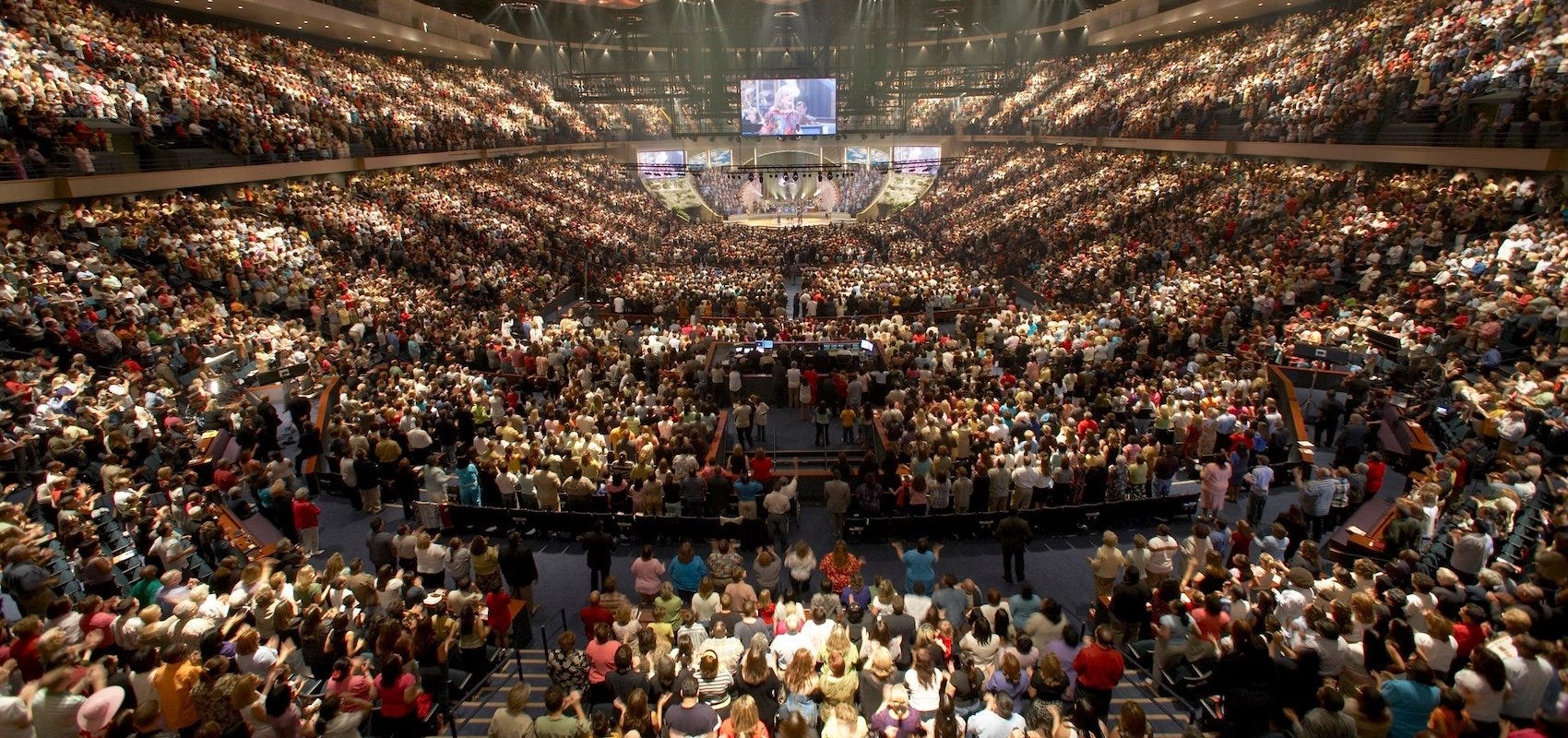
A decade ago, theologian Carl Trueman coined the term “Big Eva” to describe the rise of celebrity pastors and massive conference platforms that quietly displaced local churches.
If you’re evangelical, I’m sure you know what he’s talking about. Huge gatherings began to feel more important than small congregations as we were being fed more by our favorite podcast preachers than by our own pastors. The newest book written by a celebrity pastor overshadowed Bible study. Pressure mounted on already-exhausted church staff to reproduce the same production quality and charisma as national platforms. Stuff like that.
There were benefits, of course: wider reach for gifted communicators and unprecedented access to good teaching, in specific. I was personally blessed by it. But when it became more important than the local church, Big Eva became a big problem.
As Trueman points out, though, it seems those days are fading. What lingers is the lazy reflex to call any establishment-adjacent voice “Big Eva”—usually because they’ve written for Christianity Today, or spoke at T4G, or contribute to The Gospel Coalition, or something to that effect. Basically, if you’ve ever questioned the wisdom of Christian nationalism, or like reading Bonhoeffer, or think Kellerian “Third Way-ism” is still a virtue worth practicing, congratulations: you’re Big Eva now.
More recently, though, Trueman’s recently updated the diagnosis for our social-media age: Gig Eva.
The gig economy, in short, is the world of freelance work, i.e., independent contractors who trade institutional stability for personal flexibility. No bosses or benefits, but also no meaningful accountability. You drive your own Uber, rent out your own room, post your own content.
You are the brand. Anyone with a Røde mic, ring light, and a room with lots of shelved (mainly unread) books can freelance as a public theologian.
Now, to be fair, not everyone with an online ministry presence fits that mold. Many who speak or write online are faithful pastors and lay leaders deeply rooted in their local churches. Their digital work supplements, rather than supplants, their pastoral calling.
Still, Trueman’s concern stands: when ministry becomes a side hustle, the medium ultimately shapes the message. Gig Eva rewards charisma over character and outrage over peace. And what used to happen from pulpits and classrooms now happens from cameras and keyboards, which are, by their very nature, unaccountable and mainly driven by clicks. The result, he warns, is an evangelical culture where everyone has a platform but few have a pastor.
Something similiar, I think, is happening in Mormonism.
Call it Gig Mo.
Gig Mormonism
Once upon a time, authority in Latter-day Saint life flowed predictably: Salt Lake spoke, Deseret Book published, and BYU harmonized. The General Conference pulpit and the official manual framed what counted as faithful teaching. It was centralized and correlated. You could call this “Big Mo,” Mormonism’s equivalent to “Big Eva”.
But, as the LDS Church is learning, correlation struggles to compete with the algorithm.
Today, an entire cottage industry of independent LDS influencers has emerged. You’ll find them especially on YouTube, but also on Insta, TikTok, and in your podcast feed. They’re narrating faith crises, parsing conference talks, or defending the Church with apologetic zeal. Some are post-Mormon, but many are all-in faithful. What unites them isn’t doctrine but medium: they work the feed. They post, react, monetize, repeat. And with that has come a new kind of Mormon subculture, one that’s part de-constructive, part apologetic, and (let’s be honest) part performative.
And like their evangelical counterparts, some have grown suspicious—even dismissive—of establishment-adjacent voices. Are you part of the New Mormon History? You’re probably a compromised scholar. Do you teach at BYU? You’re definitely too close to Salt Lake. Do you have a platform? You’re probably fluent in guarded candor since the donor’s are listening.
If you spend enough time online, you can feel it. I’m not going to name names,* but perhaps you’ve sensed it, too. That tone and rhythm, that gravitational pull of personality above principle. It’s not a Left or Right, post-Mo or faithful thing—it’s an everywhere thing. It’s less about the issues or informing or dialogue than it is about brand-building. Some peddle in activist pseudo-scholarship, others chase clicks through a kind of talk-radio sensationalism, still others turn disagreement into sport and treat fellow podcasters and thought leaders like targets, not partners.
You know it when you see it.
And I don’t mean to assign influencers to a “Gig Mo” class. Think of Gig Mo less as a group and more as a mode, i.e., something anyone can slip into, even briefly, when the pull of the platform outweighs the patience of reflection.
I think Gig Mo is growing because the algorithm rewards scandal and controversy more than careful thought. It’s not that their topics and discussions are untrue or unimportant (most of the time); rather, it’s that the medium prefers emotion more than reflection. One YouTube channel I have in mind ebbs and flows in viewership, and whenever the creator needs to pump up those numbers, another hit piece on a friend of mine gets published, like clockwork.
I’ve noticed, too, that some of the Church’s defenders don’t always sound like the Brethren. At least, they don’t to me (for what it’s worth, I’m not LDS). When the Brethren plead for peacemaking, some pay that plead with lip service, but then end up defending their Zion in a spirit Zion itself might not recognize. Perhaps, as Trueman noted, that’s because the same technology that gives everyone a platform also flattens tone, so the apologist and the apostate can start to sound strangely alike, i.e., confidently certain and chronically online.
Still, I think Mormonism has one advantage over evangelicalism: it can regulate its gigs to some degree. I’ve seen this happen, like when Gig Mo goes too far, and suddenly an influencer bows gracefully (quietly) from the stage. Because unlike Big Eva, where no one can call the meeting to order, the institutional Church still can. Salt Lake owns the pulpit. If an influencer crosses a line, there are ways—soft and hard—to bring them back into orbit.
Yet, there’s a paradox here. A faith that prizes unity—indeed, sees it as a distinguishing mark from traditional Christianity—can’t easily accommodate a fully democratized discourse. The very idea of one true church sits awkwardly beside a thousand YouTube prophets. Gig Mo may feel like a renaissance of authenticity, but it also risks fragmenting the coherence Mormonism prizes.
So, I suppose, the question isn’t whether the Church can rein it in; rather, it’s whether the gig impulse can coexist with correlation. (I suspect this tension will persist for a long time.)
To be very clear, this essay isn’t meant to dismiss the many respectable and established LDS content creators who have proven to provide genuine help to people navigating their faith or providing space for that navigation to occur. (You know who you are, my friends.) But the gig model also carries familiar temptations, so I think we ought to be cautious.
Like Trueman’s Gig Eva, Gig Mo thrives on perpetual reaction. And because the gig worker’s primary accountability is to the algorithm, the line between ministering and marketing grows thin.

📘 Coming February 2026: 40 Questions About Mormonism
If you’ve appreciated this essay, you’ll love my forthcoming book, 40 Questions About Mormonism (Kregel Academic). It’s written for traditional Christians who want clear, charitable, and biblically faithful answers to the most common questions about the Latter-day Saint faith and tradition.
*Because I’m sure some folks will want an example, no, I’m still not naming any. I will clarify, though, that I don’t consider well-established podcasts to be part of what I’ve called Gig Mo, and I’ve never appeared on a show or podcast I’d put in that category. If you and I have interacted privately at a conference or online, you’re very likely not Gig Mo either because I try very hard not to keep company with that sort of thing.
Thanks for this piece Kyle, I also have noticed the increase in LDS influencers online. It's really exciting to hear so many defend the faith, but I cringe when that turns into bombastic zeal that seems to be overly confrontational or anything that just turns to be downright disrespectful.
This is really good to keep in mind. I liked these lines: "I’ve noticed, too, that some of the Church’s defenders don’t always sound like the Brethren. At least, they don’t to me (for what it’s worth, I’m not LDS). When the Brethren plead for peacemaking, some pay that plead with lip service, but then end up defending their Zion in a spirit Zion itself might not recognize."
By the way, I would love your thoughts on my new newsletter: you and Jeff from Hello Saints have inspired me to share some thoughts from an LDS perspective on interfaith relationships. I have been reading through some of your prior material and thought to myself, "This is what I want. An honest intellectual respectful take on what it seems like to those not of my faith."
Here is my first article: https://open.substack.com/pub/onefoldoneshepherd/p/what-i-would-say-in-front-of-an-interfaith?r=735ac&utm_campaign=post&utm_medium=web
I'm musing on the algorithm and clamor for attention as something new and different. Personally, I'm almost entirely engaged with the print and publication world--books and journals. One could argue that we in the print world also think about the audience and care about sales. But it feels different. Maybe it's the slower feedback loop. Maybe it's older patterns and practices. Maybe it's the nature of the people who choose one over the other. But my experience in the Mormon publishing world is that most people most of the time are thinking in terms of personal interest or what they think needs to exist or what their selected audience wants or needs, and not first about sales. That feels very different than serving an algorithm.