


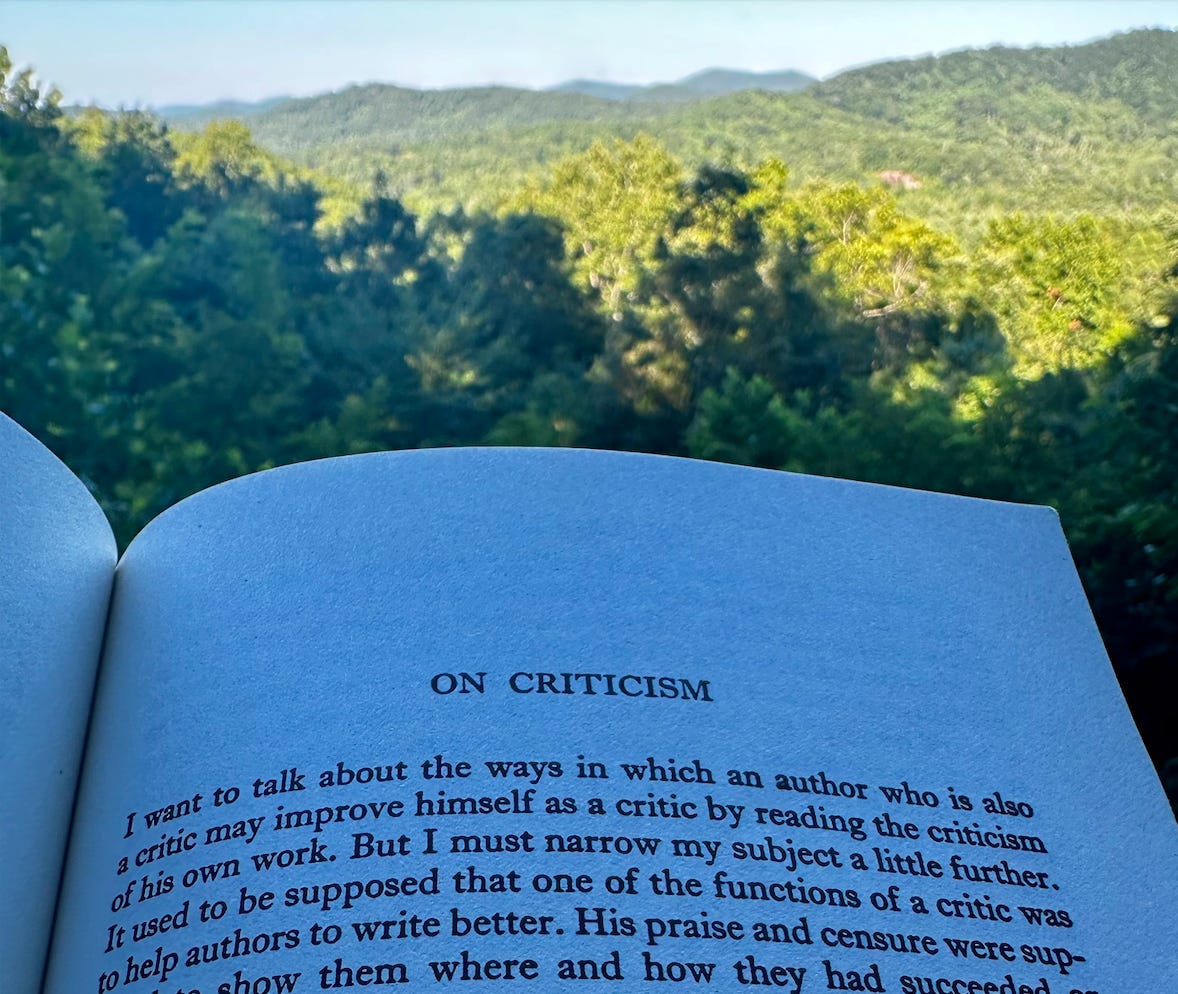
I’m writing a book review for the first time in a long while. It’s on John Turner’s biography of Joseph Smith, which will appear in the Journal of the Evangelical Theological Society (hopefully).
As I set out to do this work, I found myself reaching backward before moving forward, back to what is perhaps the best advice I’ve ever read about writing critical reviews, and about receiving criticism as an author.
If you’re a writer and you’ve never read C. S. Lewis’s essay On Criticism, I highly recommend it. You can find it [here]. If you’re not a writer, don’t worry. On Criticism has a lot of application for everyday social media, too.
The essay’s relatively short, evergreen in its wisdom, and gently persuasive in that very Lewisian way. His prose stirs curiosity rather than forcing ideas on you. Though Lewis never lived to finish On Criticism, the core of the argument stands whole.
He begins with the simple and devastating observation that we’ve largely misunderstood the role of the critic. The job, as it’s commonly assumed, is to judge a work. We read it, mull it over as we rub our chin, then slam our gavel of opinion to pronounce works “good” or “bad” like we’re handing down scholarly sentences. But for Lewis, this approach, at best, is premature. At worst, it’s arrogant.
Instead, the proper task of criticism isn’t primarily judgment but discernment, i.e., not the final word, but the first patient word, seeking to understand what a book is doing and how it works and whether we, as readers, have ears to hear it.
With that in mind, I’ve jotted down four rules for myself as I step into this review. They aren’t exhaustive, of course, but they’re a helpful beginning.
Maybe you’ll find them so, too.
Rule #1: Nothing Is “New”, Not Even That ‘Novel’ Novel
Blame it on the internet’s appetite for novelty, or the Ecclesiastian observation that we think things are novel, but the word “new” gets thrown around a lot in reviews. That’s why Lewis cautioned against calling a book or idea in a work “new.”
It may intuitively seem like a nice thing to do, if you want offer a positive review. Descriptions like ‘fresh’ and ‘original’ sound complimentary. That’s especially true in a society like ours that values innovation—‘newness’ is inherent to it. The latest is the greatest, we’re told. So, lauding an author for her ‘new’ idea or slant or take is a good thing, right?
No, says Lewis.
Labeling something ‘new’ is actually a “concealed negative” review dressed up as a positive one. The predicate ‘new’ is “committing oneself to the negative that no one had done it before. But this is beyond one’s knowledge; taken rigorously, it is beyond anyone’s knowledge.”
In other words: beware chronological snobbery dressed up as praise. The reviewer who calls something “new” may think they are applauding innovation. But what they’re actually doing is overreaching. It’s “new”? Oh, really? In what sense? In this generation? In your own reading life? And compared to what?
For example, I loved Andy Weir’s The Martian (2011), a suspenseful story about astronaut Mark Watney stranded alone on Mars with only his ingenuity and scientific knowledge to survive until rescue. But let’s be honest: The Martian borrows—likely unconsciously—from the basic premise of Robinson Crusoe (1719). It tells a very familiar story, i.e., isolation, resourcefulness, and the human drive to return home. The difference is in the details, not the substance. So, The Martian isn’t really “new” in that sense. In fact, there’s a 1964 book titled Robinson Crusoe on Mars.
And that’s okay. Why? Because… “What has been is what will be, and what has been done is what will be done, and there is nothing new under the sun,” said Ecclesiastes (1:9) thousands of years ago.
“Even my writing?” you may wonder. Yes, yours too, because “of making many books there is no end” (Ecclesiastes 12:12). It’s ok… just admit it, get over our culture’s incessant desire for ‘novelty’, and move on. Did someone write it today? I’ll give you 10:1 odds there’s a correlating general principle buried somewhere in the writings of some obscure medieval monk tucked away in Cambridge’s archives.
On a personal note, with 40 Questions About Mormonism on the publication horizion, I hope no one sees anything “new” in my approach to Mormonism. It’s different, sure—hopefully refreshing in its framing—but I stand in a long line of traditional Christians who’ve written on the subject, including the likes of Jan Shipps and Douglas J. Davies and William H. Whitsitt. I’m not comparing my skill to these scholars, only the approach they took to Mormonism.
Anyway, when reviewing or giving your opinion about a work, let your readers know what’s different or important or persuasive or tired, but don’t mistake your limited view of the past for the sweep of history.
Whether you’re writing a scholarly review or responding to someone’s post, resist the urge to declare something ‘unprecedented’ when what you really mean is that it’s unfamiliar to you.
Better to hedge than to overreach.
Rule #2: Create More Than You Criticize
This rule comes directly from Lewis’s own admonition:
“Let no one try to make a living by becoming a reviewer except as a last resource.”
A little old-fashioned? Yeah, for sure—very few people actually make a living reading and writing reviews these days. But were Lewis alive today, he’d roll his eyes at the kind who use those moody, ink-stroke New Yorker caricature avatars as their profile pic.
Anyway, I think thrust of Lewis’s command is deeply true: Criticism without creation sours the soul.
The healthiest critics—and Lewis included himself—are creators first. They write books, not just about books. They engage the world of ideas as participants, not merely as observers.
I think we’ve lost this, especially in an era when we feel compelled to offer our ‘hot’ takes about anything and everything all the time, just so people know where we stand.
Hard truth time: most people don’t care what you think about [FILL IN THE BLANK]. Sorry, it’s true. So, why are you constantly posting takes into the void?
This is particularly true on platforms like X, where the incentive structure rewards quick, biting responses over thoughtful engagement. It’s way easier to quote tweet with a snarky comment than to write something substantive. But this routine of constant criticism without corresponding creation doesn’t just make us less generous critics; rather, it makes us smaller people.
Don’t hear me wrong: the point isn’t that criticism is beneath us, but if criticism is all we do, it’s hard to be generous. Creation softens us because it reminds us how hard it is to do anything well.
So, before you set out to critique someone else’s trellis, try putting up your own first. This goes for writing and theology and ideas and politics and, well, if you think it applies, it probably does.
As a bonus, Lewis cautioned elsewhere (On Science Fiction), “Do not criticize what you have no taste for without great caution. And above all, do not ever criticize what you simply can’t stand.” If you can’t stand something, your judgment is already compromised, and the wisest move is to simply remain silent long enough to cool off and understand your reaction.
“Even a fool who keeps silent is considered wise” (Proverb 17:28).
In time, people will notice what you affirm more than what you condemn so that your loves will speak louder than your loathings.
Rule #3: Good Reviews Include the Formal Cause and Efficient Cause
When a reviewer says, “this book is bad,” most often they mean that it didn’t suit them. But Lewis says that’s not enough. A good critic will do what he did with bad beer. He may say “it is tepid, sour, cloudy, and weak”—that’s the Formal Cause. But to say why it’s bad—why it turned out that way—requires expertise. That’s the Efficient Cause. He’d need a brewer or publican [i.e., a pub manager] “to know how beer should be brewed and kept and handled.”
In other words, don’t simply explain how a book ‘tastes’ bad unless you can also explain why it does, and the same for ‘good’ books. If you don’t know the mechanics of what the author was trying to do—historical theology, narrative biography, source criticism—then you’re not in a position to diagnose why it faltered.
In common parlance: Stay in your lane. This is especially true on social media, when one’s “impressive breadth” of expertise can range from economist to virologist to military strategist all in one day.
But if you know the field, speak with clarity and charity. Critics who can name both the formal and efficient causes of a book’s success or failure are rare, but they’re definitly the ones worth reading.
Rule #4: Find the Meaning and Intention, Not Merely the Thesis
Let’s be honest: it’s relatively easy to summarize a book, assuming you’ve actually read it. (Lewis reserves some of his sharpest scorn for reviewers who haven’t.) But it’s harder—and far more valuable—to discern what a book means.
Lewis draws a careful line between two things: the intention of the author and the meaning of the book. In Lewis’s words, “It is the author who intends; the book means.”
This distinction is a corrective to critics who reduce books to either (a) what the author says about their own work, or worse, (b) what the critic thinks the author was ‘really’ trying to say. Lewis practically giggled at critics who were convinced the One Ring to Rule Them All in Lord of the Rings was the atomic bomb. “Trust me,” Lewis said, “I was there with the rest of the Inklings. That’s not what Tolkien had in mind.”
Anyway, here’s the key: intention is what the author was aiming for. The meaning is what the book actually does to readers—what it evokes, what it shapes, what it assumes, what it delivers. A good review names both, and does so without fictionalizing either.
To that end, don’t mistake the author for the book. A book isn’t a diary or a personality test. It’s a crafted thing, an independent object with its own integrity. You don’t judge a cathedral by speculating about the architect’s personal issues; rather, you walk into it and ask, “What’s it like to be in here?” In a same way, we ought to let a book define the terms of its own success before we impose our own. (That’s, like, Rule 4.1, I guess.)
This means resisting the temptation to say things like, “What the author meant to say was…” unless you have real, documented evidence. Otherwise, you’re just performing literary ventriloquism or intellectual scholarsplaining (or whatever). Stick to what the book says.
But also attend to what it does. Try to capture its voice, its movement, its emotions. Did it feel expansive or claustrophobic? Was it generous? Defensive? Ironic? None of those things? Did it carry you or push you? Did it whisper, shout, wander, build? These textures are the real stuff of meaning.
So, for example, I’m in Mormon studies, and there’s a giant that walks among us: Rough Stone Rolling by Richard Lyman Bushman. Bushman, who is a Latter-day Saint, intended to write a biography of Joseph Smith that was neither a whitewashed hagiography nor a skeptic-appealing hit piece. But the meaning of the book—what it communicates, what it makes readers feel and reckon with—is encoded in the image of the “rough stone rolling.” That’s not just a title; rather, it’s a thesis in metaphor, one that echoes through the whole reading experience. Joseph Smith, according to Bushman, was a motioned-man, unfinished and complicated and even destructive, for better or worse.
Can you name a book’s meaning in a way the author would recognize, even if they disagree with your judgment? That’s the mark of a thoughtful critic.
And here’s one more test, borrowed from Lewis himself: Can you help the reader understand what it would be like to read the book? Not just what you thought about it, but what it felt like to sit with it and walk through it and be shaped (or resisted) by it? If you can do that—if you can re-present the book faithfully, with clarity and sympathy—then your review has done something rare.
In short, Lewis says, the goal isn’t to conquer the book; rather, it’s to understand it, even if you don’t like what you understand.
Go Forth And Critique
Alright, there’s four of what I’m calling Lewis’s Rules for Criticism. Even if you are not a reviewer, I hope you can glean some wisdom as a participant in social media. The last thing you should want to ‘create’ is snark from the sidelines.
Good criticism is more art than destruction, more re-creating than demolition. It requires humility, patience, and the kind of attentiveness that creation itself demands. “Do unto others,” if I’m not mistaken. In this case, that means remembering that behind every book is someone who cared enough to try.
If I can write this upcoming review with even a trace of that spirit, I’ll count it a success.
📘 Coming Soon: 40 Questions About Mormonism
If you’ve appreciated this essay, you’ll love my forthcoming book, 40 Questions About Mormonism (Kregel Academic, this coming winter). It’s written for traditional Christians who want clear, charitable, and biblically faithful answers to the most common questions about the Latter-day Saint faith and tradition.