

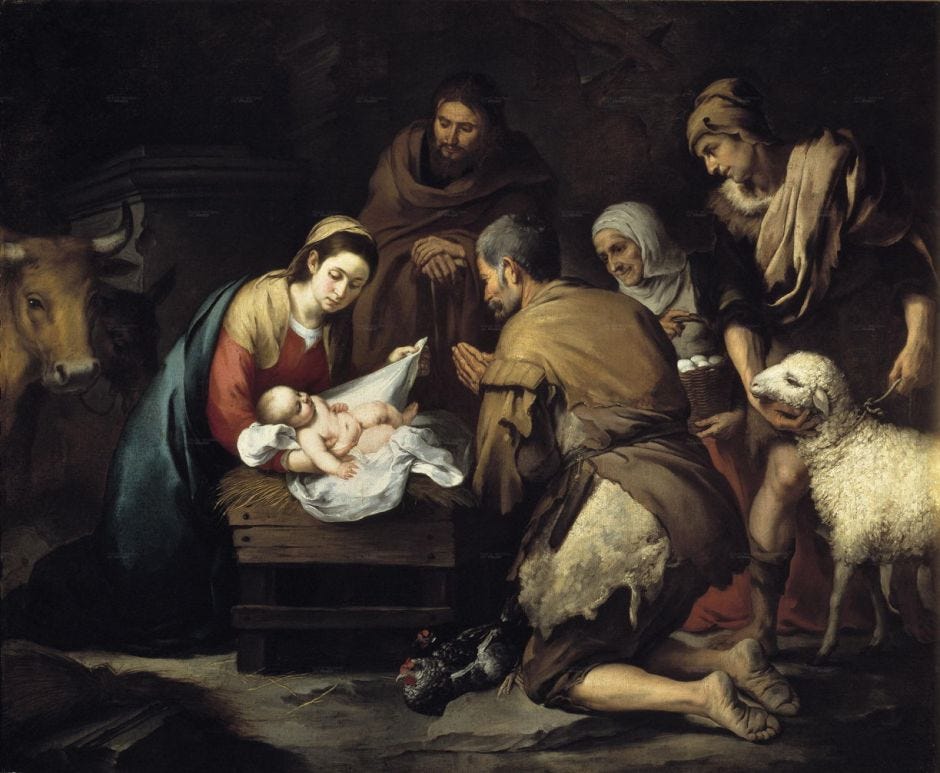
Note: This essay is based on my Christmas Eve homily. While it’s not my usual writing, I thought I’d share anyhow.
My daughter has been getting into I Spy recently.
You know the game.
Someone spots something hidden in plain sight, gives a clue, and the other person has to guess what it is.
Lately, it’s been Christmas-themed: “I spy with my little eye something tall and green with yellow teeth.”
(That’s obviously the nine-foot inflatable Grinch on the McNiven’s front yard.)
My kid loves it, I think, because it rewards curiosity and attention. If I’m honest, I love it, too, because it suggests the world still has meaning tucked inside it, waiting to be found.
I’m glad the Bible tells us this instinct isn’t childish at all.
“It is the glory of God to conceal things, but the glory of kings is to search things out.” (Proverbs 25:2)
God delights to hide truth, but not to keep it from us. He wants us “search things out,” to look again, carefully this time. Which makes the Nativity of the Gospel accounts something like a holy game of I Spy. If you look closely, you’ll notice how God placed clues everywhere, little signs that interpret themselves once we know what to look for.
Jesus gave us those clues.
He told us who He is and why He came, especially in His “I am” statements found in the Gospel of John. And when you stare long enough at the Nativity, you begin to see them.
I Spy Something Bright
Jesus said,
“I am the light of the world. Whoever follows me will not walk in darkness, but will have the light of life” (John 8:12).
Where’s that light in the Nativity?
It shines overhead.
The star pierces the night sky, visible from far away, drawing strangers to worship a child they never met. “For we saw his star when it rose and have come to worship him” (Matthew 2:2), said the magi.
No offense to all the amateur astronomers trying to prove this was an actual event—I think it was—but that’s beside the point.
The point is the world Jesus entered: a dark world.
Darkness in the Bible is less a statement about the absence of daylight than it is the presence of something wrong, something broken, something menacing. Darkness means sin, confusion, fear, estrangement from God, death.
It’s into that darkness God sent His only Son.
“For God loved the world in this way: He gave his one and only Son, so that everyone who believes in him will not perish but have eternal life.” John 3:16, CSB
Granted, the light doesn’t erase the darkness instantly—there’s still sin and suffering in the world—but it gives direction, making movement “out of darkness into his marvelous light” possible (see 1 Peter 2:9). Remember, God’s Son came not to condemn the world, but to redeem it (see John 3:17). “For the Son of Man came to seek and to save the lost” (Luke 19:10).
Light means we’re no longer lost.
I Spy Something Standing Watch
Jesus said,
“I am the good shepherd. The good shepherd lays down his life for the sheep” (John 10:11).
Where are the shepherds in the Nativity?
This one’s easy.
In the Nativity story, shepherds are everywhere. They’re awake while others sleep, watching their flocks in the open fields at night (see Luke 2:8).
Why shepherds? Because of the cost they pay to protect their flocks. They know the risks, that sheep wander and can’t defend themselves from predators. So, it’s bad news when they wander from shepherd care.
It’s doubly bad news to know that, “All we like sheep have gone astray” (Isaiah 53:6).
The world Jesus enters, then, wasn’t just dark; it was dangerous, filled with deception, temptation, and evil that seeks to abuse and oppress and kill (see 1 Peter 5:8).
It still is.
The presence of shepherds at Jesus’s birth signals that this child has come to stand between danger and the vulnerable, between Satan and sinner. He doesn’t flee when the cost becomes clear—His own death on a cross.
He gives himself.
I Spy Something to Eat
(This one is my favorite.)
Jesus said, “I am the bread of life,” and then pressed the claim further:
“I am the living bread that came down from heaven. If anyone eats of this bread, he will live forever. And the bread that I will give for the life of the world is my flesh” (John 6:48, 51).
“Wait… Where is bread in the Nativity?” you wonder.
It’s right there in the center of the scene: the manger.
Think about it. We’ve tamed the Nativity too much. To us, the manger is basically a makeshift crib, safe and cute.
But let’s be real: a manger is a feeding trough.
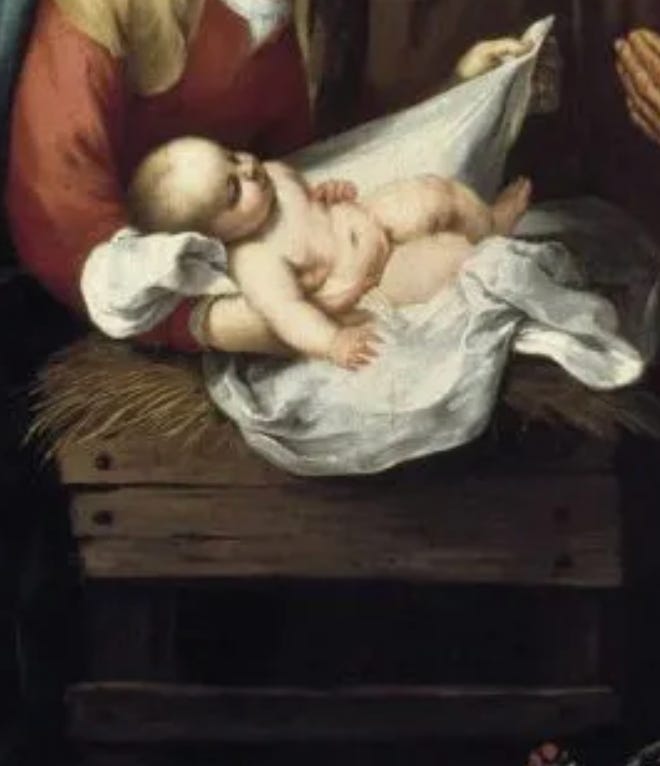
The word “manger” comes from the Latin mandere, which means “to chew.” It’s the same root word where the English “mandible” comes from (jawbone).
Sure, it was a makeshift crib, but toss the pragmatism aside for a moment, you kings, to ‘search out’ what God has ‘concealed’ here: God placed the Bread of Life in a feeding trough to show that salvation would come by consuming.
From the very beginning of Christ’s life, He was placed where food belongs, to be consumed by the creatures He created (see Colossians 1:16–17).
Bread is broken, shared, received. Jesus didn’t arrive merely to be observed or admired or even followed. He came to be given for the life of the world.
Receive Him by faith.
Merry Christmas, friends.