



An earlier edition made the connection between Joseph Smith and John Calvin too strongly. Thanks to feedback from Mack Werner, I have revised the essay to more carefully make the argument.
On August 18, 1833, Joseph Smith wrote to leaders of the Church of Christ in Jackson County, Missouri.
Earlier that month, news had reached him of the mob violence there in late July. Anti-Mormons destroyed the Latter-day Saint printing office in Independence, and tarred and feathered one of their leaders. By the time Joseph learned of all this, the persecuted Saints had already agreed to leave by the following year. Sadly, things would only get worse from there.
Their pain and departure was hard to accept for Joseph. His people were, after all, turning away from the New Jerusalem he believed God, via the mouth of a living prophet in the End Times, commanded them to build.
No wonder Joseph opened his letter with a prayer:
O thou disposer of all Events, thou dispencer of all good! in the name of Jesus Christ I ask thee to inspire my heart.1
I came across this moment while doing some research for a project on Mormon history. I immediately noticed the phrase “dispence of all good” as unoriginal to Joseph Smith.
I’d first come across it in John Calvin’s Institutes, his chapter “Of Prayer,” in which he describes God “the sovereign disposer of all good” (III.20.1).

It means that every good thing—every mercy, every provision, every laugh, every cool breeze on a hot summer’s day—all of it has its origin in God’s will, and comes to us by His hand at His good pleasure. “Disposer” sounds odd, but bear in mind the older sense of the word, i.e., not one who discards, but one who arranges or allots. God, then, is the arranger and distributor of all good things, the sovereign source from whom every gift flows.
For Calvin, this confession is the ground of prayer itself, because God alone gives, and we are the ones who ask. And it just so happens that Joseph Smith began his prayer with an extremely similiar phrase.
Where Calvin wrote “sovereign,” Joseph wrote “disposer of all Events.”
Where Calvin wrote “disposer of all good,” Joseph wrote “dispencer of all good.”
Well, technically, Calvin didn’t write “disposer” at all. He wrote bonorum omnium dominum ac largitorem, “the Lord and giver of all good things.” Largitor means a giver, a bestower, one who grants generously. It was his popular English translator, Henry Beveridge, who in 1845 rendered largitor as “disposer.”
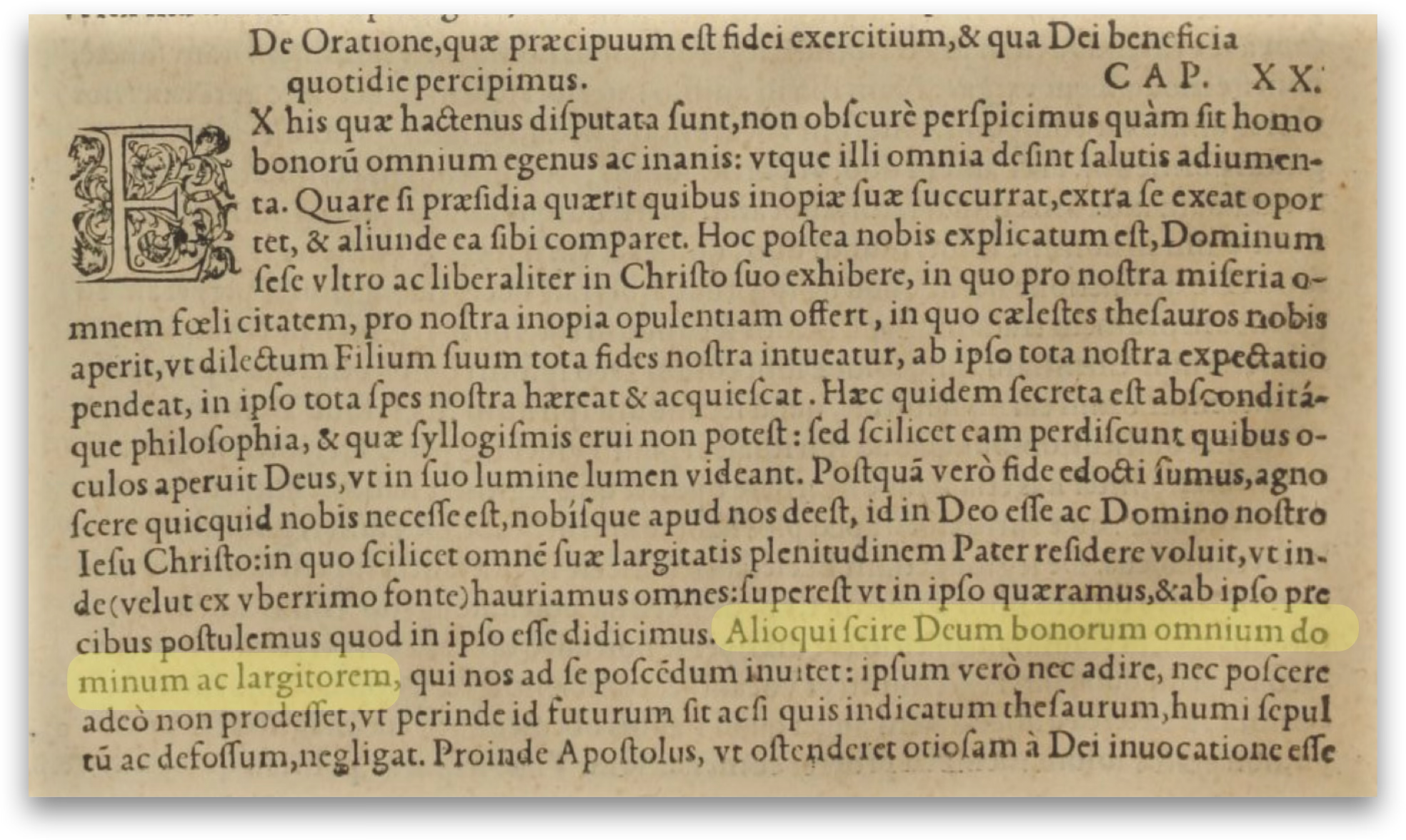
Beveridge published his translation in 1845, twelve years after Joseph wrote his letter. Yet, the phrase “disposer of all good” was hardly a rare at the time. By the 1830s, it was ordinary providential English. As one reader pointed out, when John Quincy Adams opened his 1825 annual message to Congress, he gave thanks to “the Omnipotent Disposer of All Good.” The words also turn up in sermons and prayers across the young republic.
None of this was distinctively Calvinist, but it was thoroughly biblical, and every Protestant tradition held it. The taproot, I think, is the book of James: “Every good gift and every perfect gift is from above, and cometh down from the Father of lights” (James 1:17). Calvin’s largitor, Beveridge’s disposer, the founders’ providential thanks, and Joseph’s prayer all draw from that same source. God is the giver of all good, which is among the least controversial confessions of the Christian faith.
Set aside the words for a moment to notice the structure, because it’s the same for both Joseph and Calvin. Joseph wrote, “Disposer of all Events,” so God is soverign over everything that happens. Then, he wrote “Dispencer of all good,” which means God gives whatever is good.
God is great, God is good.
That’s the same two-step Calvin took, as did countless Christians before him. In fact, the idea—God as the disposer of all good—had by 1833 become part of the ordinary piety of Anglo-American Protestantism, its sermons and prayers and hymnals, and part of the very grammar with which a person addressed God in a prayerful moment of grief. And when Joseph, under the weight of news he could barely stand beneath, began his prayer, this is the phrase that showed up first.
Wild, right?
At least, it was a bit jarring to me.
I think that’s because—and maybe I’m not alone—I tend to read Joseph as a figure cleanly severed from what came before him. I know he’s not; I know that for a fact.
But still, it seems to be my default mode Joseph Smith.
Perhaps the First Vision is the reason? The narrative frames it that way, anyway. Two personages—God the Father and Jesus Christ—telling a fourteen-year-old boy that the Christian creeds are an abomination, forbidding him from formally associating with any church. For many Latter-day Saints I’ve spoken with or read, they receive that story as a decisive break with corrupted Christendom. And my fellow evangelicals, well, we see it as Joseph’s decisive rupture with traditional Christianity.
Both readings present something common: Joseph on one side of the line, traditional Christianity on the other.
But prayer is a strange revealer, isn’t it?
Joseph’s prayer summoned Protestant language, the kind of language that formed his soul early in life. By his childhood, I’m assuming, that phrase—sovereign disposer of all good—was common enough among all Protestant denominations that I provided a strong unifying theme: God is gracious, God is good.
And Joseph hadn’t let go of that.
Not even in turmoil.
Obviously, none of this collapses the theological distance between Joseph and the tradition he left. That distance is quite large. But it does complicate the tidy picture of Josephs Smith I keep defaulting to.
Maybe it does for you as well.

📘 40 Questions About Mormonism
If you’ve appreciated this essay, you’ll love 40 Questions About Mormonism (Kregel Academic). It’s written for traditional Christians who want clear, charitable, and biblically faithful answers to the most common questions about the Latter-day Saint faith and tradition.
JSP D3:262.
Latter-day Saints also "tend to read Joseph as a figure cleanly severed from what came before him." Which does cause some disorientation, I think, whenever it happens that he wasn't completely removed from the world he was living in. Like you said, jarring and disorientation.
A big one is -- in Joseph Smith history, Joseph presents the story of the first vision by saying: "I was one day reading the Epistle of James, first chapter and fifth verse..."
William Smith & Oliver Cowdery both remark that the Methodist preacher Rev. George Lane, had been preaching on James 1:5, and that Joseph attended a revival where this verse was preached upon.
Most people perfunctorily familiar with LDS Church History only know the "official account," which, like every story, has to pick a spot to begin, and a spot to end. And, it doesn't start with the Methodist revival. But, with Joseph reading. It creates the perspective that Joseph was "cleanly severed from what came before him." But, perhaps he wasn't in this case. He just took what came before him, and stretched it out farther than it had been before. Took it a little further.
It is an interesting note when it comes to writing histories. How are stories framed? How are they presented? Does it unintentionally create the wrong idea? Is it intentionally trying to teach something different.